Valentine’s Day

A Brief History of Valentine’s Day

220px-St-Valentine-Kneeling-In-SupplicationEach year on February 14th we celebrate Valentine’s Day. It is a time for romance, love and for many a great excuse to play kissy-face with a chosen sweetheart!  But the origins of the day are actually dark, bloody — and a bit muddled.

Though no one has pinpointed the exact origin of the holiday, one good place to start is ancient Rome, where men hit on women by, well~ by hitting them!

On February 14 around the year 278 A.D., Valentine, a holy Christian priest in Rome back in the days of Emperor Claudius II, was executed for performing too many Christian marriages. Indeed, Emperor Claudius II actually executed two men — both named Valentine — on Feb. 14, each in different years in the 3rd century A.D. and their martyrdom was honored by the Catholic Church with Valentine (Valentinus in latin) the priest’s canonization and the eventual celebration of St. Valentine’s Day. Ironic; huh?  Celebrating a day devoted to romance and love on the anniversary date of the poor man’s execution!

From February 13 to 15, the Romans celebrated the feast of Lupercalia. The men sacrificed a goat and a dog, then whipped women with the hides of the animals they had just slain. Those silly Roman romantics got drunk & naked and young women would actually line up for the men to hit them, because they believed this would make them fertile. (Oh, those wild and crazy Romans!) The brutal party included a matchmaking lottery, where young men drew the names of women from a jar. The couple would then be coupled up for the extent of the festival — or longer, if the match was right.

In the 5th century sometime between 492 – 496 A.D., Pope Gelasius I, mixed things up a bit by combining St. Valentine’s Day with Lupercalia in order to banish the pagan rituals. But the festival became more of a theatrical interpretation of what it had once been. Regardless, the holiday was still celebrated as a day of fertility and love.

Legend has it that while in jail awaiting execution for preaching Christianity~ St. Valentine left a farewell note for the jailer’s daughter, who had become his friend, and he signed it, “From Your Valentine”. So there you have it in a nutshell! ~ JGT

My Valentine’s Day Story

While serving in the U.S. Navy during the mid-1980’s, I met & married my husband, Luke. We had met a little more than a year earlier, on a Friday  afternoon, while I was reporting for duty at NRC Fort Wadsworth (later NAVSTA), Staten Island, NY. During the check-in process, it was customary for the sponsor, in my case, the Chief Petty Office on duty, to introduce incoming personnel to department heads. When we reached the “Library” I was greeted by an empty desk but introduced to a sailor wearing blue coveralls who was obviously busy rummaging through stacks of paperwork beneath the counter.  A few seconds passed before I heard a loud ‘thump’ and Luke stood up and muttered, “Welcome aboard” while rubbing his throbbing scalp where it had just collided with the countertop.

As required, I had reported in full dress uniform and Luke confessed to me a few years later that he had been so distracted by staring at my legs, that he didn’t realize the distance between his head and the countertop was as close as it was! How romantic was that? Oh, and by the way; did I forget to mention that it was also Valentine’s Day?!?

Happy Valentine’s Day, Bear! “I never knew what I always wanted, until I met you!”  ~ As Ever, D~~

Me & Luke Christmastime 198720110824163248723

Valentine’s Day

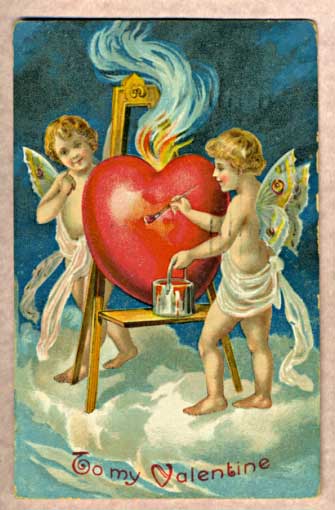
Antique_Valentine_1909_01Each year on February 14th, many people exchange cards, candy, gifts or flowers with their special “valentine.” The day of romance we call Valentine’s Day is named for a Christian martyr and dates back to the 5th century, but has origins in the Roman holiday Lupercalia.

Every February 14, across the United States and in other places around the world, candy, flowers and gifts are exchanged between loved ones, all in the name of St. Valentine. But who is this mysterious saint, and where did these traditions come from? The history of Valentine’s Day–and the story of its patron saint–is shrouded in mystery. We do know that February has long been celebrated as a month of romance, and that St. Valentine’s Day, as we know it today, contains vestiges of both Christian and ancient Roman tradition. But who was Saint Valentine, and how did he become associated with this ancient rite?

The Catholic Church recognizes at least three different saints named Valentine or Valentinus, all of whom were martyred. One legend contends that Valentine was a priest who served during the third century in Rome. When Emperor Claudius II decided that single men made better soldiers than those with wives and families, he outlawed marriage for young men. Valentine, realizing the injustice of the decree, defied Claudius and continued to perform marriages for young lovers in secret. When Valentine’s actions were discovered, Claudius ordered that he be put to death.

Other stories suggest that Valentine may have been killed for attempting to help Christians escape harsh Roman prisons, where they were often beaten and tortured. According to one legend, an imprisoned Valentine actually sent the first “valentine” greeting himself after he fell in love with a young girl–possibly his jailor’s daughter–who visited him during his confinement. Before his death, it is alleged that he wrote her a letter signed “From your Valentine,” an expression that is still in use today. Although the truth behind the Valentine legends is murky, the stories all emphasize his appeal as a sympathetic, heroic and–most importantly–romantic figure. By the Middle Ages, perhaps thanks to this reputation, Valentine would become one of the most popular saints in England and France.

While some believe that Valentine’s Day is celebrated in the middle of February to commemorate the anniversary of Valentine’s death or burial–which probably occurred around A.D. 270–others claim that the Christian church may have decided to place St. Valentine’s feast day in the middle of February in an effort to “Christianize” the pagan celebration of Lupercalia. Celebrated at the ides of February, or February 15, Lupercalia was a fertility festival dedicated to Faunus, the Roman god of agriculture, as well as to the Roman founders Romulus and Remus.

To begin the festival, members of the Luperci, an order of Roman priests, would gather at a sacred cave where the infants Romulus and Remus, the founders of Rome, were believed to have been cared for by a she-wolf or lupa. The priests would sacrifice a goat, for fertility, and a dog, for purification. They would then strip the goat’s hide into strips, dip them into the sacrificial blood and take to the streets, gently slapping both women and crop fields with the goat hide. Far from being fearful, Roman women welcomed the touch of the hides because it was believed to make them more fertile in the coming year. Later in the day, according to legend, all the young women in the city would place their names in a big urn. The city’s bachelors would each choose a name and become paired for the year with his chosen woman. These matches often ended in marriage.Lupercalia survived the initial rise of Christianity and but was outlawed—as it was deemed “un-Christian”–at the end of the 5th century, when Pope Gelasius declared February 14 St. Valentine’s Day. It was not until much later, however, that the day became definitively associated with love. During the Middle Ages, it was commonly believed in France and England that February 14 was the beginning of birds’ mating season, which added to the idea that the middle of Valentine’s Day should be a day for romance.

Valentine greetings were popular as far back as the Middle Ages, though written Valentine’s didn’t begin to appear until after 1400. The oldest known valentine still in existence today was a poem written in 1415 by Charles, Duke of Orleans, to his wife while he was imprisoned in the Tower of London following his capture at the Battle of Agincourt. (The greeting is now part of the manuscript collection of the British Library in London, England.) Several years later, it is believed that King Henry V hired a writer named John Lydgate to compose a valentine note to Catherine of Valois.

In addition to the United States, Valentine’s Day is celebrated in Canada, Mexico, the United Kingdom, France and Australia. In Great Britain, Valentine’s Day began to be popularly celebrated around the 17th century. By the middle of the 18th, it was common for friends and lovers of all social classes to exchange small tokens of affection or handwritten notes, and by 1900 printed cards began to replace written letters due to improvements in printing technology. Ready-made cards were an easy way for people to express their emotions in a time when direct expression of one’s feelings was discouraged. Cheaper postage rates also contributed to an increase in the popularity of sending Valentine’s Day greetings.

Americans probably began exchanging hand-made valentines in the early 1700s. In the 1840s, Esther A. Howland began selling the first mass-produced valentines in America. Howland, known as the “Mother of the Valentine,” made elaborate creations with real lace, ribbons and colorful pictures known as “scrap.” Today, according to the Greeting Card Association, an estimated 1 billion Valentine’s Day cards are sent each year, making Valentine’s Day the second largest card-sending holiday of the year.

See the Full Article courtesy of the History Channel.