US Navy

A Brief History of Valentine’s Day

220px-St-Valentine-Kneeling-In-SupplicationEach year on February 14th we celebrate Valentine’s Day. It is a time for romance, love and for many a great excuse to play kissy-face with a chosen sweetheart!  But the origins of the day are actually dark, bloody — and a bit muddled.

Though no one has pinpointed the exact origin of the holiday, one good place to start is ancient Rome, where men hit on women by, well~ by hitting them!

On February 14 around the year 278 A.D., Valentine, a holy Christian priest in Rome back in the days of Emperor Claudius II, was executed for performing too many Christian marriages. Indeed, Emperor Claudius II actually executed two men — both named Valentine — on Feb. 14, each in different years in the 3rd century A.D. and their martyrdom was honored by the Catholic Church with Valentine (Valentinus in latin) the priest’s canonization and the eventual celebration of St. Valentine’s Day. Ironic; huh?  Celebrating a day devoted to romance and love on the anniversary date of the poor man’s execution!

From February 13 to 15, the Romans celebrated the feast of Lupercalia. The men sacrificed a goat and a dog, then whipped women with the hides of the animals they had just slain. Those silly Roman romantics got drunk & naked and young women would actually line up for the men to hit them, because they believed this would make them fertile. (Oh, those wild and crazy Romans!) The brutal party included a matchmaking lottery, where young men drew the names of women from a jar. The couple would then be coupled up for the extent of the festival — or longer, if the match was right.

In the 5th century sometime between 492 – 496 A.D., Pope Gelasius I, mixed things up a bit by combining St. Valentine’s Day with Lupercalia in order to banish the pagan rituals. But the festival became more of a theatrical interpretation of what it had once been. Regardless, the holiday was still celebrated as a day of fertility and love.

Legend has it that while in jail awaiting execution for preaching Christianity~ St. Valentine left a farewell note for the jailer’s daughter, who had become his friend, and he signed it, “From Your Valentine”. So there you have it in a nutshell! ~ JGT

My Valentine’s Day Story

While serving in the U.S. Navy during the mid-1980’s, I met & married my husband, Luke. We had met a little more than a year earlier, on a Friday  afternoon, while I was reporting for duty at NRC Fort Wadsworth (later NAVSTA), Staten Island, NY. During the check-in process, it was customary for the sponsor, in my case, the Chief Petty Office on duty, to introduce incoming personnel to department heads. When we reached the “Library” I was greeted by an empty desk but introduced to a sailor wearing blue coveralls who was obviously busy rummaging through stacks of paperwork beneath the counter.  A few seconds passed before I heard a loud ‘thump’ and Luke stood up and muttered, “Welcome aboard” while rubbing his throbbing scalp where it had just collided with the countertop.

As required, I had reported in full dress uniform and Luke confessed to me a few years later that he had been so distracted by staring at my legs, that he didn’t realize the distance between his head and the countertop was as close as it was! How romantic was that? Oh, and by the way; did I forget to mention that it was also Valentine’s Day?!?

Happy Valentine’s Day, Bear! “I never knew what I always wanted, until I met you!”  ~ As Ever, D~~

Me & Luke Christmastime 198720110824163248723

THE PLEDGE OF ALLEGIANCE

The Pledge of Allegiance was originally written in August 1892 by a Socialist Minister, Francis Bellamy (1855-1931) from New York. He originally wrote it to promote Socialism & eventually the rise of Nazism in Europe and the United States.  Originally published in The Youth’s Companion on September 8, 1892, Bellamy had hoped that the pledge would be used by citizens in any country.
In its original form, it read:  “I pledge allegiance to my Flag and the Republic for which it stands, one nation, indivisible, with liberty and justice for all.”

In 1923, a National Flag Conference, presided over by the American Legion and the Daughters of the American Revolution, ordained that “my flag” should be changed to “the flag of the United States,” lest immigrant children be unclear just which flag they were saluting. The following year, the Flag Conference refined the phrase further, adding “of America.”  In 1942, the pledge’s 50th anniversary, Congress adopted it as part of a national flag code. By then, the salute had already acquired a powerful institutional role, with some state legislatures obligating public school students to recite it each school day.
A decade later, following a lobbying campaign by the Knights of Columbus—a Catholic fraternal organization—and others, Congress approved the addition of the words “under God” within the phrase “one nation,  indivisible.” On June 14, 1954, President Dwight Eisenhower signed the bill into law making it the same 31-word “Pledge” we recite today.
Section 4 of the United States Flag Code states:  “I pledge allegiance to the Flag of the United States of America, and to the Republic for which it stands, one Nation under God, indivisible, with liberty and justice for all.”

The Pledge should be observed by standing at attention facing the flag with the right hand over the heart. When not in uniform men should remove any non-religious headdress with their right hand and hold it at the left shoulder, the hand being over the heart. Persons in uniform should remain silent, face the flag, and render the military salute. ~JGT


“A Day That Will Live in Infamy” (Japanese Attack Pearl Harbor, Hawaii)

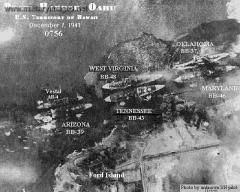
  1. Aerial_photograph_from_unknown_jap_aviator_over_Pearl_Harbo

On an otherwise calm Sunday morning on December 7, 1941, the Japanese shocked the world by bombing the American naval bYase at Pearl Harbor, Hawaii.

This ‘dastardly attack’ was the turning point for America and for the War.

On December 8, the nation was gathered around its radios to hear President Roosevelt deliver his “Day of Infamy” speech. That same day, Congress declared war on Japan. On December 11, Congress declared war on Germany.

The slogan ‘Remember Pearl Harbor’ mobilized a nation and helped awaken the mighty war machine and economic engine that was America.

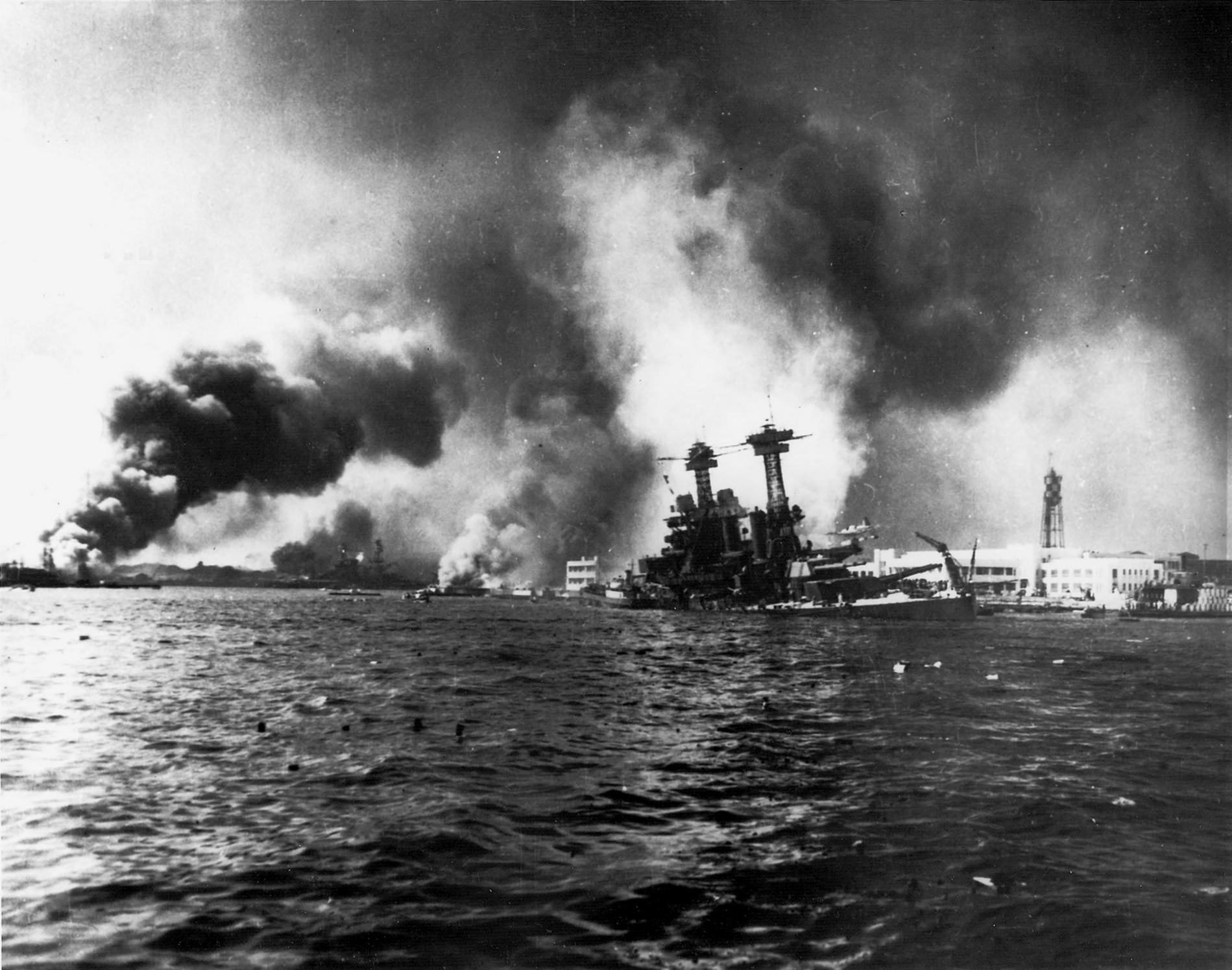
**Eighty three years ago~ just before 8 a.m. on December 7, 1941, a Japanese dive bomber bearing the red symbol of the Rising Sun of Japan on its wings appears out of the clouds above the island of Oahu. A swarm of 360 Japanese warplanes followed, descending on the U.S. naval base at Pearl Harbor in a ferocious assault. The barrage lasted just two hours, but it was devastating: The Japanese managed to destroy nearly 20 American naval vessels, including eight enormous battleships, and almost 200 airplanes. More than 2,000 Americans soldiers and sailors died in the attack, and another 1,000 were wounded.

USS_California_sinking-Pearl_Harbor

The surprise attack struck a critical blow against the U.S. Pacific fleet and drew the United States irrevocably into World War II. The day after the assault, President Franklin D. Roosevelt asked Congress to declare war on Japan; Congress approved his declaration with just one dissenting vote. Three days later, Japanese allies Germany and Italy also declared war on the United States, and again Congress reciprocated. More than two years into the conflict, America had finally joined World War II.

With diplomatic negotiations with Japan breaking down, President Franklin D.

PH 1941

Roosevelt and his advisers knew that an eminent Japanese attack was probable, but nothing had been done to increase security at the important naval base at Pearl Harbor. It was Sunday morning, and many military personnel had been given passes to attend religious services off base. At 7:02 a.m., two radar operators spotted large groups of aircraft in flight toward the island from the north, but, with a flight of B-17s expected from the United States at the time, they were told to sound no alarm. Thus, the Japanese air assault came as a devastating surprise to the naval base.

Uss Arizona

Much of the Pacific fleet was rendered useless: Five of eight battleships, three destroyers, and seven other ships were sunk or severely damaged, and more than 200 aircraft were destroyed. A total of 2,400 Americans were killed and 1,200 were wounded, many while valiantly attempting to repulse the attack. Japan’s losses were some 30 planes, five midget submarines, and fewer than 100 men. Fortunately for the United States, all three Pacific fleet carriers were out at sea on training maneuvers. These giant aircraft carriers would have their revenge against Japan six months later at the Battle of Midway, reversing the tide against the previously invincible Japanese navy in a spectacular victory.

The day after Pearl Harbor was bombed, President Roosevelt appeared before a

ntyph

joint session of Congress and declared, “Yesterday, December 7, 1941–a date which will live in infamy–the United States of America was suddenly and deliberately attacked by naval and air forces of the Empire of Japan.” After a brief and forceful speech, he asked Congress to approve a resolution recognizing the state of war between the United States and Japan. The Senate voted for war against Japan by 82 to 0, and the House of Representatives approved the resolution by a vote of 388 to 1. The sole dissenter was Representative Jeannette Rankin of Montana, a devout pacifist who had also cast a dissenting vote against the U.S. entrance into World War I. Three days later, Germany and Italy declared war against the United States, and the U.S. government responded in kind.

The American contribution to the successful Allied war effort spanned four long years and cost more than 400,000 American lives.

Eighty-three Years ago, our parents & perhaps our grandparents learned of the atrocity perpetrated by the Japanese that was Pearl Harbor. Today our country is faced with a similar invasion with the incursion of our country by Illegal Aliens, Drug Smugglers, Criminals and significantly: Jihadi Terrorists. Some are even referred to as “home-grown” yet they are nonetheless invaders of our homeland, America! ALL Terrorists whether foreign-born or natural-born Americans are evil in my opinion and a threat to American Lives & Liberty. Call it whatever you like but today, the growing threat to America is Islamic Terrorism most believed to be instigated by the Islamic State of Iraq and the Levant also referred to as ISIS. So, my brother & sister Americans & Patriots~ during this holiday season, remember to say your prayers, kiss your loved ones, be vigilant & arm yourselves because America is once again under attack by Radical Ideology, Illegal Aliens & Islamic Jihadists! (Beware: The Barbarians are at the Gates.) Meanwhile, I wish you all a Merry Christmas & Happy New Year! ~ JGT (updated) 12/6/2018

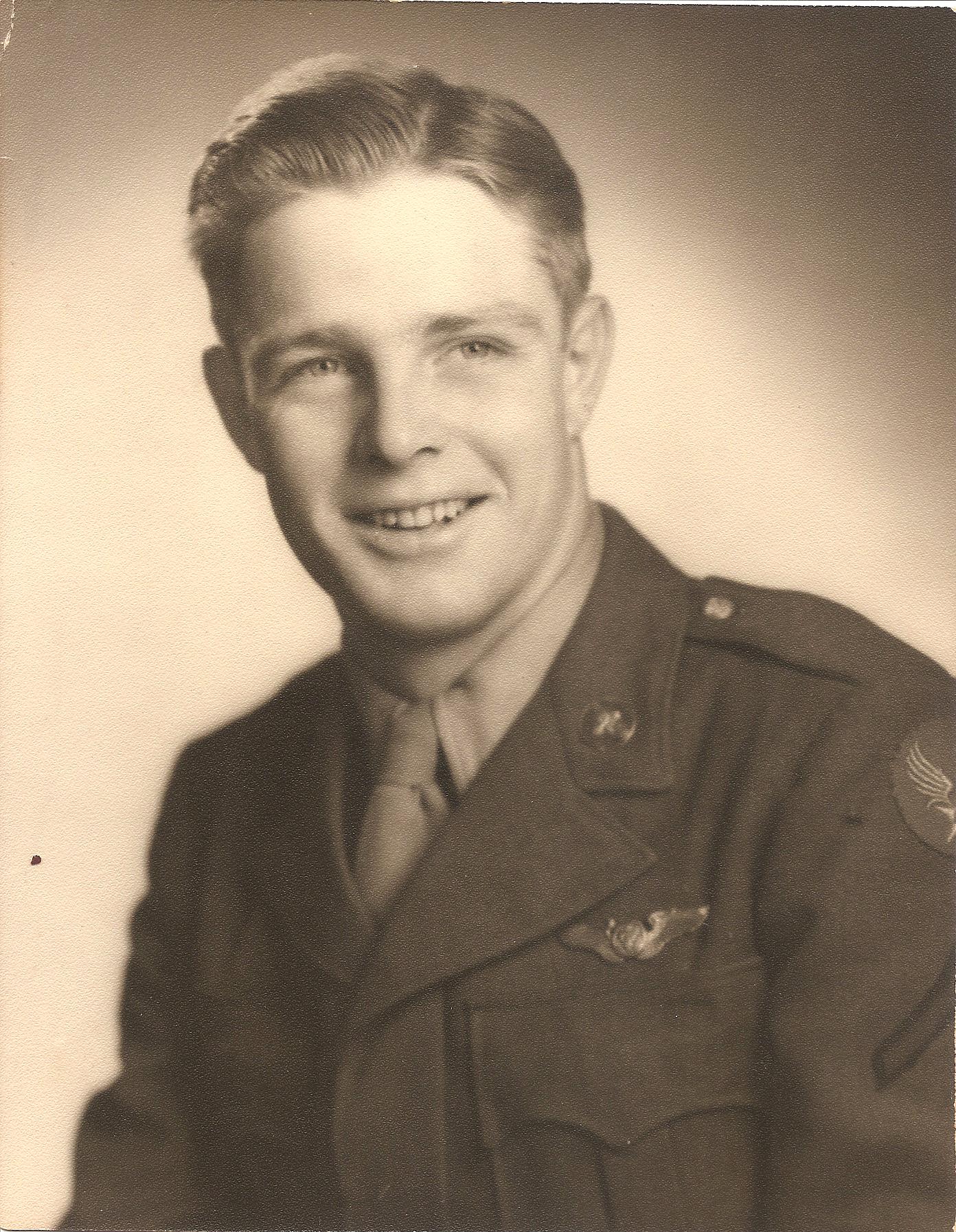
(Pictured L to R) My Father, Donald W. Flint, WWII Army Air Corps (Circa 1942) & My Father-in-Law, John Howard, US Army Ranger (Circa 1943)

Thank you, Daddy & Pop~ for your devotion & service to our country. You set great examples for your children, all US Navy & Marine Corps Veterans. We miss and love you both! ~ dfh

DONALD W. FLINT USAF WWII 001

Howard,_John_(website)

“Old Glory” & the History of “Flag Day” in America

Did you know that the week of June 12–18, 2024 is designated as National Flag Week. “Old Glory” or rather, the American “Stars and Stripes” which originated as a result of a resolution adopted by the Marine Committee of the Second Continental Congress at Philadelphia on June 14, 1777. The resolution read: Resolved, that the flag of the United States be thirteen stripes, alternate red and white; that the union be thirteen stars, white in a blue field representing a new constellation.”

The resolution gave no instruction as to how many points the stars should have, or how the stars should be arranged on the blue union. Consequently, some flags had stars scattered on the blue field without any specific design, some arranged the stars in rows, and some in a circle. The first Navy Stars and Stripes had the stars arranged in staggered formation in alternate rows of threes and twos on a blue field. Other Stars and Stripes flags had stars arranged in alternate rows of four, five and four. Some stars had six points while others had eight.

Strong evidence indicates that Francis Hopkinson of New Jersey, a signer of the Declaration of Independence, was responsible for the stars in the U.S. flag. At the time that the flag resolution was adopted, Hopkinson was the Chairman of the Continental Navy Board’s Middle Department. Hopkinson also helped design other devices for the Government including the Great Seal of the United States. For his services, Hopkinson submitted a letter to the Continental Admiralty Board asking “whether a Quarter Cask of the public Wine will not be a proper & reasonable Reward for these Labours of Fancy and a suitable Encouragement to future Exertions of a like Nature.” His request was subsequently turned down since the Congress regarded him as a public servant.

According to legend, in 1776, George Washington commissioned Philadelphia seamstress Betsy Ross to create a flag for the new nation. Scholars debate this legend, but agree that Mrs. Ross most likely knew Washington and sewed flags. To date, there have been twenty-seven official versions of the flag, but the arrangement of the stars varied according to the flag-makers’ preferences until 1912 when President Taft standardized the then-new flag’s forty-eight stars into six rows of eight. The forty-nine-star flag (1959-60), as well as the fifty-star flag, also have standardized star patterns. The current version of the flag dates to July 4, 1960, after Hawaii became the fiftieth state on August 21, 1959.

The first celebration of the U.S. Flag’s birthday was held in 1877 on the 100th anniversary of the Flag Resolution of 1777. However, it is believed that the first annual recognition of the flag’s birthday dates back to 1885 when school teacher, BJ Cigrand, first organized a group of Wisconsin school children to observe June 14 – the 108th anniversary of the official adoption of The Stars and Stripes as the Flag’s Birthday. Cigrand, now known as the ‘Father of Flag Day,’ continued to publically advocate the observance of June 14 as the flag’s ‘birthday’, or ‘Flag Day’ for years.

In 1916, the anniversary of the Flag Resolution of 1777 became a nationally observed event by a proclamation by President Woodrow Wilson thus establishing a national Flag Day on June 14 each year. Americans have commemorated the adoption of the Stars and Stripes by celebrating June 14 as Flag Day. Prior to 1916, many localities and a few states had been celebrating the day for years. Congressional legislation had already designated that date as the national Flag Day and it was signed into law by President Harry Truman in 1949; the legislation also called upon the president to issue a Flag Day proclamation every year. However, it was not designated as National Flag Day until August 3rd, 1949, when an Act of Congress designated June 14th of each year as National Flag Day.

Though Flag Day is neither a federal holiday nor one can declare it as an official leave the state of Pennsylvannia was the first and foremost state in the U.S. who declared & celebrated Flag Day as a state holiday on June 14th 1937.

Today, Flag Day is celebrated throughout the country with parades, essay contests, ceremonies, and picnics sponsored by veterans’ groups, schools, and groups like the National Flag Day foundation whose goal is to preserve the traditions, history, pride, and respect that are due the nation’s symbol, Old Glory.

Pledge

I AM AN AMERICAN SAILOR

I Am An American Sailor!th5D0OF9UM

Hear my voice, America!  Though I speak through the mist of 200 years, my shout for freedom will echo through liberty’s halls for many centuries to come. Hear me speak, for my words are of truth and justice, and the rights of man. For those ideals I have spilled my blood upon the world’s troubled waters. Listen well, for my time is eternal -yours is but a moment. I am the spirit of heroes past and future! 

I am the American Sailor. I was born upon the icy shores at Plymouth, rocked upon the waves of the Atlantic, and nursed in the wilderness of Virginia. I cut my teeth on New England codfish, and I was clothed in southern cotton. I built muscle at the halyards of New Bedford whalers, and I gained my sea legs high atop mizzen of Yankee clipper ships.

Yes, I am the American Sailor, one of the greatest seamen the world has ever known. The sea is my home and my words are tempered by the sound of paddle wheels on the Mississippi and the song of whales off Greenland’s barren shore. My eyes have grown dim from the glare of sunshine on blue water, and my heart is full of star-strewn nights under the Southern Cross. My hands are raw from winter storms while sailing down round the Horn, and they are blistered from the heat of cannon broadside while defending our nation.  I am the American Sailor, and I have seen the sunset of a thousand distant, lonely lands.

 bonhomme_richardI am the American Sailor. It was I who stood tall beside John Paul Jones as he shouted, “I have not yet begun to fight!”  I fought upon the Lake Erie with Perry, and I rode with Stephen Decatur into Tripoli harbor to burn Philadelphia.  I met Guerriere aboard Constitution, and I was lashed to the mast with Admiral Farragut at Mobile Bay. I have heard the clang of Confederate shot against the sides of Monitor. I have suffered the cold with Peary at the North Pole, and I responded when Dewy said, “You may fire when ready Gridley,” at Manila Bay.  It was I who transported supplies through submarine infested waters when our soldiers were called “over there.”  I was there as Admiral Byrd crossed the South Pole.  It was I who went down with the Arizona at Pearl Harbor, who supported our troops at Inchon, and patrolled dark deadly waters of the Mekong Delta. 

 thI6IANB6VI am the American Sailor and I wear many faces. I am a pilot soaring across God’s blue canopy and I am a Seabee atop a navy-seal3dusty bulldozer in the South Pacific. I am a corpsman nursing the wounded in the jungle, and I am a Torpedoman in the Nautilus deep beneath the North Pole. I am hard and I am strong. But it was my eyes that filled with tears when my brother went down with the Thresher, and it was my heart that rejoiced when Commander Shepherd rocketed into orbit above the earth. It was I who languished in a Viet Cong prison camp, and it was I who walked upon the moon. It was I who saved the Stark and the Samuel B. Roberts in the mine infested waters of the Persian Gulf.  It was I who pulled my brothers from the smoke filled compartments of the Bonefish and wept when my shipmates died on the Iowa and White Plains. When called again, I was there, on the tip of the spear for Operations Desert Shield and Desert Storm.

 I am the American Sailor.  I am woman, I am man, I am white and black, yellow, red and brown. I am Jew, Muslim, Christian, and Buddhist. I am Irish, Filipino, African, French, Chinese, and Indian.  And my standard is the outstretched hand of Liberty. Today, I serve around the world; on land, in air, on and under the sea. I serve proudly, at peace once again, but with the fervent prayer that I need not be called again. Tell your children of me. Tell them of my sacrifice, and how my spirit soars above their country. I have spread the mantle of my nation over the ocean, and I will guard her forever.  I am her heritage and yours. ~ I am the American Sailor.   (Written by: ~MUCM J. Wallace, USN)


PN1 Dorian F. Howard, US Navy 1979 – 1990



ENC Luke D. Howard, US Navy- Retired (1978 – 1999)


My husband & I met in 1986 and married the following March. Three months later, Luke deployed back to sea duty. His ship, (USS Butte AE-27)  was part of the USS Saratoga CV-60 battle group that was on deployment in the Mediterranean Sea. The year was 1987.  The mission was highly Top Secret so I didn’t hear from him for several months!   Ever heard of Operation Goldenrod ? Keeping secrets from your wife after only a few months of marriage can be deadly, however; this Navy wife understood completely!  And yes, we’re still married!


SUPPORT OUR PRESIDENT

The following was written by a dear friend of mine, whom I have known since my U.S. Navy days ~ way back when our country really was GREAT & then President Ronald Reagan led the American People with strength and our Military respectfully as Commander in Chief.  Then President Reagan, vowed to destroy the “Evil Empire” (referring of course, to the Iron Curtain countries) and low & behold~ the Berlin Wall came down & the Soviet Union was abolished by 1989. Indeed, with regard to his “Peace through Strength” doctrine, President Reagan responded to the Iranian attack on the USS Samuel B. Roberts, sailing in open waters of the Persian Gulf on 14 April 1988 with his approval of “Operation Praying Mantis“.

Mr. Reagan said, “They must know that we will protect our ships, and if they threaten us, they will pay a price.”

Operation Praying Mantis remains the largest surface battle engaged in by the U.S. Navy since World War II, and its outcome was decisive. According to official reports released afterward, using a combination of anti-ship missiles, naval gunfire, and aircraft launched from several ships, including the aircraft carrier the USS Enterprise, the Navy destroyed 2 oil platforms used by Iran for intelligence collection, sank 4 small Iranian Navy boats, sank an Iranian frigate, and severely damaged another Iranian warship.

But that was all on April 18, 1988. Back when the United States believed in delivering swift, decisive responses to enemy provocations. ~ JGT

FACEBOOK POST: February 16, 2017 by John M. Grashof, SMC, USN-Retired

What a bunch of crap. We get a guy in the white house who wants to do the right thing………and he gets attacked from all sides. Be it popular vote, electoral vote………..Trump won. He wants what the voters wanted. A wall. Keep possible terrorists out of the country. A better health plan that benefits EVERYONE. Better care for Veterans. Better jobs. Better pay. A fair trade deal with our trading partners, a stronger military……..The side show is the media, congress and the senate. The idiots in congress and senate say “We were here before he got here, and will be here after he leaves”………I get it. Checks and balances. But my gawd………….if its a good deal, makes sense, helps our economy, helps job growth, and is nothing but positive………..then for crying out loud…………..either reconsider your vote for scumbags like Nancy Pelosi and Chuck Schumer and all the other dopes that do nothing but hinder progress………..and make your voice heard loud and strong. TRUMP COULD CARE LESS ABOUT ANY RICHES HE GETS FROM HIS ELECTION. HE RAN BECAUSE HE THOUGHT HE COULD DO SOME GOOD……………Both parties are up in arms over Trumps decisions to date. Keep in mind. Not every senator, not every congressman are playing with a full deck. Trump admonished both senate and congress as being “DO NOTHINGS”……..He is right !!!!!!! They don’t do squat !!!! To them, its a lifelong career…….Its a good ole boy organization…….

I implore all those, that take sides in this political forum, go back some years and understand what this country is about………..and understand what has taken place to undermine our political system. Right is right, and wrong is wrong. God in our schools is right.. God out of our schools is wrong…….5 signs to say where one can pee is wrong, 2 signs to say where one can pee is right.

The sanctitity of the police in our society and what they stand for is good……..the notion that they are our enemies is bad.

The USA religion: Its Christianity. Our language is English. Abide, or feel free to find a better place to speak your language or practice your religion……..Why do the majority of this country have to cowtow to the minority ? …………What happened that the majority have to feel oppressed over their beliefs, and this “feel good society” has taken the front seat ? Seriously, whose toes are we stepping on ?………..Go to Iran, go to the majority of the middle east countries and practice your religion, your rights your beliefs as you do here in the USA and see what happens.

Back to Trump. He doesn’t need this headache. Guaranteed. He doesn’t. He has ALL he needs. He’s merely trying to do the right thing. Make America Great Again. Notice, there is no “Apology Tour” ?………He actually feels America is a great country. He said he would do what the voters wanted him to do…….but he has to deal with the “SWAMP”……..He is right !!! Washington is the Swamp !…….

He irks the GOP as well as the Dems. Its a power struggle.

This nation is divided. For sure. Over ideology. Over lots of stuff.

I know that a president cannot simply rule based on executive orders. Its not what our nation was built on. We need congress and the senate to play fair with the president. I’m not seeing this. What I’m seeing is many playing a power play……which may or may not be to the betterment of our country…..

In closing, please pray in earnest for this president. Please pray in earnest for this country. We are a diverse nation, many backgrounds, many various beliefs, etc……but, I believe this country has a guy in office right now who wants nothing but the best for this country……..Give Him the Support that he needs. He is less than 30 days in office and has been thru the ringer. Cut him some slack……..Pray for him that he sees his way thru the mud and slime and can make good on his promises.


Thanks, John;  for allowing me to post your patriotic opinion on my website. Affectionately, Dorian~

The Battle of Monmouth ~ June 28th 1778

300px-BattleofMonmouthOn June 28, 1778, approximately 11,000 troops of the Continental Army (which included members of the New Jersey & Pennsylvania Militias) led by General George Washington & Major General Charles Lee, faced off against 14,500 British regulars led by Lieutenant General Sir Henry Clinton, Major General Earl Cornwallis and Major General Knyphausen at Monmouth Courthouse in New Jersey.
Although the Americans held the field and claimed victory, it is generally regarded as a draw, since the British were successful at defending their baggage train. This would be the last battle fought between the two MAIN armies as well as the longest. The remaining battles of the Revolutionary War would be fought by secondary forces in the southern states (colonies).

The Americans loved harassing the British by burning bridges, cutting down trees across roads & muddying wells & streams thus slowing down the march of the Redcoats and especially the Hessian troops who were carrying heavy backpacks & sweating profusely in the sweltering 98 degree June heat. Many of them fell from heat exhaustion and many more deserted. Indeed, the British only advanced about 40 miles a week!

As was his habit to dither & complain, General Lee continued advising Washington that he shouldn’t commit the American Army against British Regulars. However; in spite of Lee & his other generals, Washington ignored Lee’s advice because he knew that his troops are now trained and better equipped than they had been before and that he could not afford losing a major engagement at that point in the war. Yet; Washington also knew that the British would be vulnerable to attack since their army was now spread out widely across the state as he pursued them into New Jersey once leaving Valley Forge.

*Note: Washington & his army had spent the previous winter (1777/1778) in considerably deplorable conditions at Valley Forge, PA. Early on there was a lack of food and supplies. The Americans were suffering from starvation as well as influenza, dysentery, typhoid and typhus which killed two-thirds of the nearly 2,000 soldiers who died but the situation eventually improved with the proper issue of equipment and food rations. Once Washington put Prussian, Baron von Steuben in charge of training the American Regiments, morale improved and the Americans became eager to engage the British in the Spring.

The British left Philadelphia on 18th June 1778 and began the laborious march to the North-East into New Jersey. General Washington marched east from Valley Forge into New Jersey, determined to intercept the British. The two armies came face to face at Monmouth Courthouse, NJ.

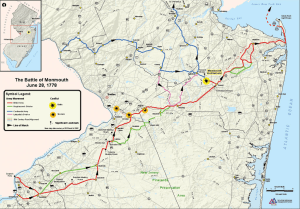
General Washington moved his army forward with advanced force of some 4,000 troops which was designated to attack the marching British Army and cut it in half. He offered the command of this assault to Major General Charles Lee who eventually agreed to take charge once the troop force was increased to 5,000 men.  Lee had the task of attacking the British column in the flank and delaying it so that the main American army could come up and join the battle.NJ map Battle

The New Jersey militia warned that the British army was on the move so Washington ordered Lee to attack and bring the British withdrawal to a halt until he could bring up the main strength of the American army along the Monmouth Road. Lee lay to the west of the Middletown road and should have delivered a coordinated attack on the slow moving column. Properly executed, Lee could have halted the British withdrawal to the north east and enabled the main American army under Washington to attack from the rear.

However; history records that Lee gave no proper orders to his commanders and permitted them to commit their troops as they saw fit. Various skirmishes with small parties of British troops took place as Lee’s force moved tentatively forward towards the Middletown Road. Confused fighting broke out with Clinton’s rearguard, largely composed of British regiments. Finally, Lee ordered his troops to into a cowardly retreat on the main American army. As he withdrew down the road, Clinton launched his troops in pursuit.

General Washington, bringing the main American army along the Monmouth road, encountered, not the rear of the British column, but Lee’s regiments, retreating in considerable disorder with the British advancing behind them.

*Memorably this is the one occasion Washington is said to have sworn. He deployed a consignment of oaths directed at Lee, to the admiration of those listening, before ordering Lee to the rear. Washington then galloped forward and began the task of rallying Lee’s disordered troops.

Washington ordered General Wayne, with the last of Lee’s regiments, Stewart’s 13th Pennsylvania and Ramsay’s 3rd Maryland, to form to the North of the road and hold the British advance. These regiments resisted strongly but were driven back by the British 16th Light Dragoons. Their stand gave Washington the time to form the rest of the American army, with artillery on Comb’s Hill to the South of the road. Ferocious fighting took place as the British attempted to drive back the American line. This was the first test of Steuben’s re-trained American Continental Foot regiments and they withstood the trial well. As the evening wore on, the British troops fell back, and returned to their journey north, leaving the Americans on the field. ~ Dorian F. Howard© 2016

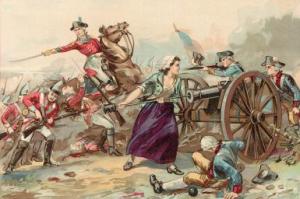
Illustration depicting American widow Mary Ludwig Hays McCauley (1754 - 1832), nicknamed 'Molly Pitcher,' stoking a cannon for the US Pennsylvania artillery in the Battle of Monmouth, during the American Revolutionary War, Freehold, New Jersey, June 1778. She replaced her fallen husband John Hays as a cannon loader. (Photo by Kean Collection/Getty Images)

The Battle of Monmouth is often remembered for the legend of “Molly Pitcher.” While many of the details regarding “Molly Pitcher” have been embellished or are in dispute, the story refers to a woman who brought water to American artillery during the battle. This water was intended for swabbing the guns during the reloading process as well as cooling the hot gun crew. In one version of the story she replaced her husband on a gun crew when he fell wounded or from heat stroke. The Molly Pitcher of Monmouth, New Jersey is generally identified Mary Ludwig Hayes. 


DEMOCRATS PUT BOTH FEET IN THEIR MOUTH!

pelosi-watters-idiots

A History of the New Year

A Move from March to January by Borgna Brunner

The celebration of the new year on January 1st is a relatively new phenomenon. The earliest recording of a new year celebration is believed to have been in Mesopotamia, c. 2000 B.C. and was celebrated around the time of the NewYearsEvevernal equinox in mid-March. A variety of other dates tied to the seasons were also used by various ancient cultures. The Egyptians, Phoenicians, and Persians began their new year with the fall equinox, and the Greeks celebrated it on the winter solstice.
Early Roman Calendar: March 1st Rings in the New Year

The early Roman calendar designated March 1 as the new year. The calendar had just ten months, beginning with March. That the new year once began with the month of March is still reflected in some of the names of the months. September through December, our ninth through twelfth months, were originally positioned as the seventh through tenth months (septem is Latin for “seven,” octo is “eight,” novem is “nine,” and decem is “ten.”

January Joins the Calendar

The first time the new year was celebrated on January 1st was in Rome in 153 B.C. (In fact, the month of January did not even exist until around 700 B.C., when the second king of Rome, Numa Pontilius, added the months of January and February.) The new year was moved from March to January because that was the beginning of the civil year, the month that the two newly elected Roman consuls—the highest officials in the Roman republic—began their one-year tenure. But this new year date was not always strictly and widely observed, and the new year was still sometimes celebrated on March 1.

Julian Calendar: January 1st Officially Instituted as the New Year

In 46 B.C. Julius Caesar introduced a new, solar-based calendar that was a vast improvement on the ancient Roman calendar, which was a lunar system that had become wildly inaccurate over the years. The Julian calendar decreed that the new year would occur with January 1, and within the Roman world, January 1 became the consistently observed start of the new year.

Middle Ages: January 1st Abolished

In medieval Europe, however, the celebrations accompanying the new year were considered pagan and unchristian like, and in 567 the Council of Tours abolished January 1 as the beginning of the year. At various times and in various places throughout medieval Christian Europe, the new year was celebrated on Dec. 25, the birth of Jesus; March 1; March 25, the Feast of the Annunciation; and Easter.

Gregorian Calendar: January 1st Restored

In 1582, the Gregorian calendar reform restored January 1 as new year’s day. Although most Catholic countries adopted the Gregorian calendar almost immediately, it was only gradually adopted among Protestant countries. The British, for example, did not adopt the reformed calendar until 1752. Until then, the British Empire —and their American colonies— still celebrated the new year in March.

Article written by: Borgna Brunner & Reprinted Courtesy of  http://www.infoplease.com/spot/newyearhistory.html

I’d like to wish a very Happy New Year to ALL of my brother & sister Military Veterans & those brave Navy, Marine Corps, Air Force, Army, Coast & National Guard personnel currently serving on Active Duty around the world!  God Bless You ALL & Thank You for Your Service to our Country! ~JGT

Christmas 1776 – The Battle of Trenton

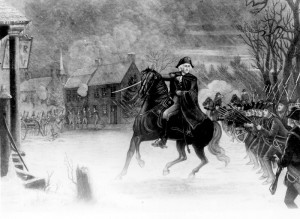
George-Washington--300x219

Christmas of 1776 marked the first major victory for the Continental Army.  Several months earlier, General Washington’s troops lost New York City to the British and eventually retreated south.  The British army chased the Americans through New Jersey and Delaware en route to Philadelphia, the Continental capital.  The situation was made even more dire by the prospect of a vastly reduced number of Continental troops after December 31, when enlistments were due to expire.

In early December the Continental Army crossed the Delaware and destroyed or captured all watercraft for a 75-mile stretch along the river to deter the British from crossing.  The British leaders evidently thought the Continental Army was no threat, and General Howe decided to move his men into winter quarters in Trenton, Pennington and Bordentown, New Jersey, with a base of operations in Brunswick.

Washington decided to make a bold move and attack Trenton, where Hessian troops were wintering.  On December 25, the Americans formed into three divisions and were to cross the river at three separate locations once night fell.  Washington personally led one division.  The weather was poor.  Ice chunks were floating in the river, and the falling snow soon turned to sleet and hail driven by a bitterly cold wind.  Once the troops – many lacking warm winter clothing and shoes – crossed the river, they marched nine miles to the town of Trenton.  The Hessian soldiers were celebrating Christmas in a traditional German style, never expecting an attack on the morning of December 26.

The Continental Army’s overwhelming victory at Trenton had several important consequences.  The Americans managed to capture more than 900 men and their weapons and accouterments, and lost only two soldiers.  British General Howe was so stunned by the outcome of Trenton that he sent for General Cornwallis, who was about to board a ship for England, to return to New Jersey to command the army.  For the American cause, Trenton was a great morale booster, and General Washington became an overnight hero! 

Article courtesy of http://www.historyisfun.org/blog/christmas-1776/