This year, June 6, 2024~ marks the 80th Anniversary of the Normandy Invasion. WWII’s D-Day.

Immediately after the Japanese attack on Pearl Harbor the Allies created the “Combined Chiefs of Staff” (CCS) comprising of the United States Joint Chiefs of Staff and the British Chiefs of Staff. Their function was to assist and advise U.S. President Roosevelt and British Prime Minister Churchill on the direction and conduct of the war. The CCS confirmed a previous policy of “Germany First” and, from March 1942, their planning group began work on an outline plan for a full-scale invasion of Europe. They initially hoped to invade Europe in 1943 but the realities of insufficient materials and manpower, and the demands of other operations agreed upon, delayed this effort until 1944 – this despite persistent agitation from Russian Dictator, Stalin to open a second front to relieve pressure in the East.
When America joined the war on the side of Britain in 1941, the two made plans to retake France from the Germans. The situation looked bleak. Britain was running out of food, Western Europe was under the Nazi heel, and the Soviet Union was near collapse. The Russians were begging for an immediate second front to stop the Germans. It was clear that an U.S. invasion of Germany itself was necessary to overthrow Hitler.
Operation Overlord, also known as the Normandy Invasion or simply D-Day, was the code name for the Allied invasion of northern Europe in World War II. It began with the landings on the beaches of Normandy in northwestern France on June 6, 1944, and accomplished the largest amphibious invasion in the history of mankind, using 200,000 men, 9,000 planes, and over 5,000 ships.
Operation Neptune was the name given to the Naval Armada of allied ships & the allied Air Corps involved. On the

whole, the naval fleet was composed of five forces, one for each beach. (Utah, Omaha, Gold, Juno & Sword) Utah & Omaha beaches were invaded by American Forces. The other three by British, Canadian & a free French Battalion. Eight to sixteen distinct convoys composed the five principal convoys. These forces represented more than 5300 ships of all types plus the 4000 relay boats between the shore and the ships. During the landing, 3460 heavy bombers and 1650 light bombers dropped hundreds of tons of bombs on the Normandy coast, targeting the batteries and the fortifications of the German’s Atlantic Wall. The 82nd and 101st American airborne divisions had been parachuted in hours preceding the amphibian offensive, in the western sector of the allied invasion, West and South-west of Utah Beach, located in the Cotentin peninsula. Once on the ground, the Americans of the 82nd and 101st got under way immediately towards their objectives. Despite an extremely high number of losses (50% in the only night of June 6, 1944), the American parachutists of the 82nd and 101st Airborne achieved a great number of their missions.
Years in the planning~ the Battle of Normandy was fought during World War II in the summer of 1944, between the Allied nations and German forces occupying Western Europe. Seventy years later, the Normandy Invasion, or D-Day, remains
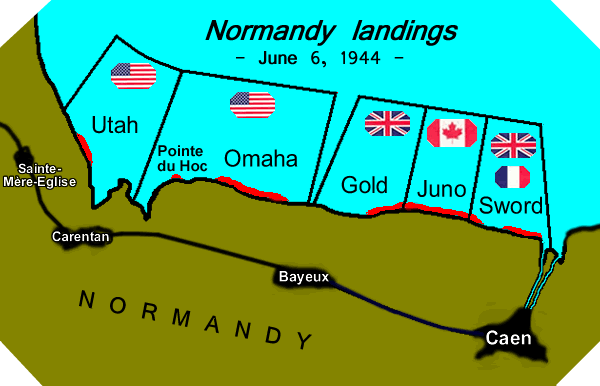
the largest seaborne invasion in history, involving nearly three million troops crossing the English Channel from England to Normandy in occupied France. Twelve Allied nations provided fighting units that participated in the invasion, including Australia, Canada, Belgium, France, Czechoslovakia, Greece, New Zealand, the Netherlands, Norway, Poland, the United Kingdom, and the United States. The American, British, and Canadian troops were under the command of U.S. General Dwight D. Eisenhower, and crossed the English Channel on June 6, 1944, landing on six beaches along sixty miles of the Normandy coast. Their intention was to drive German forces east and out of France while Russian forces in Eastern Europe slowly pushed west. The heaviest fighting occurred at Omaha Beach, where perhaps as many as 3,000 American men were killed or wounded. By contrast, fewer than 200 casualties (out of 23,000 soldiers engaged) were suffered at Utah, the next beach over.
Operation Overlord was the codename for the Allied invasion of northwest Europe. The assault phase, or the establishment of a secure foothold, was known as Operation Neptune. Operation Neptune began on D-Day (June 6, 1944) and ended on June 30, when the Allies had finally established a firm foothold in Normandy. Operation Overlord continued until Allied forces crossed the River Seine on August 19, 1944.
The battle began months before the invasion, when Allied bombers began to pound the Normandy coast and farther south, to destroy transportation links, and disrupt the German army’s build-up of their military strength. More than 300 planes dropped 13,000 bombs over Normandy in advance of the invasion. Six parachute regiments, with more than 13,000 men, also went ahead to cut railroad lines, blow up bridges, and seize landing fields. Gliders also brought in men, light artillery, jeeps, and small tanks. ~ D. F. Howard© June 1, 2014
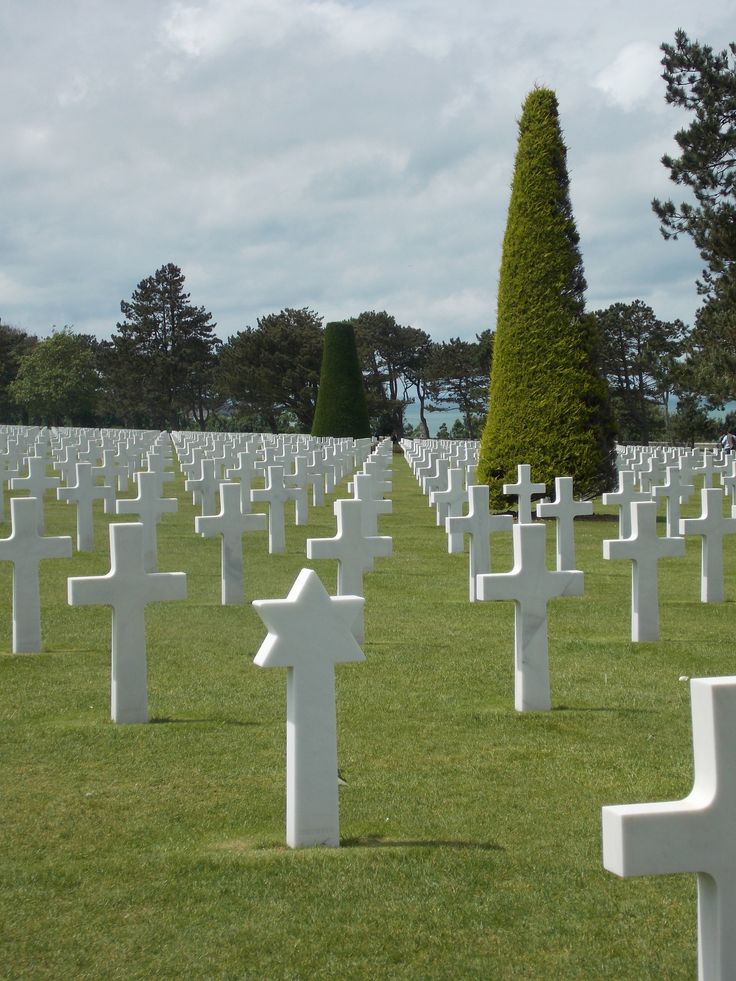
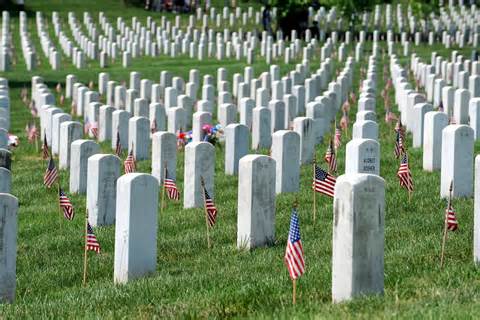
Portion of the American Cemetery in Normandy, France.
Death Tolls: Germany had 320,000 deaths, followed by the United States with 135,000, then the United Kingdom, Canada, and France where the last three all with less than 65,000.
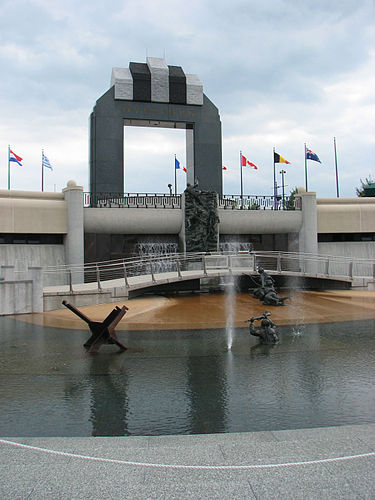
The OVERLORD ARCH located at the National D-DAY Memorial in Bedford, Virginia USA.
Courtesy of Wikipedia. The National D-Day Memorial is a war memorial located in Bedford, Virginia. It serves as the national memorial for American D-Day veterans. However, its scope is international in that it states, “In Tribute to the valor, fidelity and sacrifice of Allied Forces on D-Day, June 6, 1944” and commends all Allied Armed Forces during the D-Day invasion of Normandy, France on June 6, 1944 during World War II.[1] The memorial, bordering the Blue Ridge Mountains in southwestern Virginia, is an area comprising 88 acres (360,000 m2) that overlooks the town of Bedford. It officially opened on June 6, 2001 with 15,000 people present, one of whom was then-President George W. Bush.[2] About 70,000 people have visited the memorial each year. Of those, more than half are from outside of Virginia. Bedford was selected for the National D-Day memorial because the town suffered the greatest per capita loss of life during the invasion of any town in the country.[3]
**Note”” As a U.S. Navy Veteran & wife of a Retired US Navy Chief Petty Officer, as well as the daughter & daughter-in-law of two wonderful WWII Veteran fathers ~ this Jersey Girl couldn’t help but include a link to the Naval History & Heritage page on the D-Day Landings on June 6, 1944. ~ JGT
GOD BLESS AMERICA!
Honor Courage Commitment!

Thank you to My Daddy & Pop Howard for your honorable sacrifice(s) during this horrific (WWII) War. Your children (Veterans) also knowingly respect the personal sacrifices you made for our wonderful country & to all of the Citizens of ~ The GREAT United States of America!
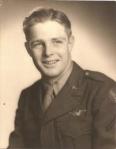
Donald W. Flint US Army Air Force 1942 – 1945

John Howard, US Army, 1942 -1943


 Here It Is! Detailed List of Findings in Wikileaks DNC Document Dump
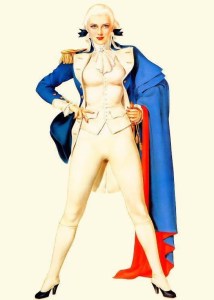 I love America! I love MY country! I love what our Constitution stands for and I love it for the dream that our founding fathers imagined for us. I would give my life for my country!
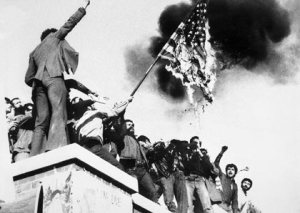 In 1979, the United States allowed the then exiled, Shah of Iran entry into our country for medical treatment. Meanwhile; a group of radical Islamists in Tehran violently seized our American Embassy there, burned our flag, looted and destroyed our Embassy (American Territory) & took over 54 American Citizen hostages These Americans were held captive in that disgusting country for 444 days! Eventually; President Carter acted by Executive Order in November of that year by freezing about $12 Billion Iranian assets which included bank deposits, gold & property. But the harm was already done to his weak administration because Americans remained captive in Iran until a new President was sworn into office in January 1981.
  prohibited all trade with Iran. Later that year, Congress passed the Iran-Libya Sanctions Act (ILSA) which included foreign company penalties if they engaged in over $20 Million of petroleum development in Iran.
 “The United States and Iran today have settled a long outstanding claim at the Iran-U.S. Claims Tribunal in the Hague.
 David Bowie’s opening tandem of Paul Simon’s “America and his own “Heroes”, dedicated to his local ladder company. ————————–
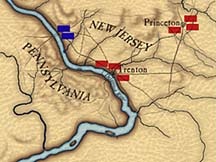 Many Americans don’t realize that George Washington & his troops crossed and re-crossed the Delaware River a total of four times in the waning days of 1776. The first time was in early December when he left New Jersey in retreat from the British.
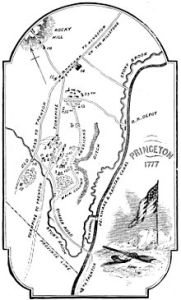 British General Howe orders General Lord Cornwallis to Princeton to gather all available troops for a counter attack. On January 2nd, Cornwallis marches on Trenton with about 6000 men, leaving three regiments of the 4th Brigade at Princeton as rear-guard, under Colonel Charles Mawhood. At Maidenhead (now Lawrenceville) on Jan 2nd, the British meet with American units who begin a fighting withdrawal, ambushing and delaying the British. It is 4 PM when the British finally get to Trenton, to find Washington entrenched but out-numbered and outclassed. Washington has but 5,200 men, many unreliable militia. Washington has deployed his troops on the south side of Assunpink Creek, a strong position, and repels several attempts of the British to take the bridge. Night eventually fell. Since his troops are tired, Cornwallis decided to wait to attack until the morning, when he can “bag the fox” as he called it. His officers want to attack now, fearful of Washington’s known ability to retreat and escape but Cornwallis remained arrogantly steadfast believing that a mere rabble of farmers could never defeat British regulars.
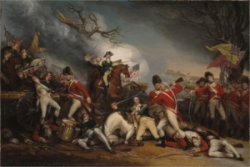 4th Brigade followed by the 55th, and the 40th regiment ordered to remain in Princeton. Now the Americans under General Hugh Mercer who had been sent to guard the left flank and the 17th under Mawhood discover each other at the same time, and move to attack. The 55th moves back into Princeton. Mercer and Mawhood each believe they have encountered a patrol. Mawhood has about 276 men, and Mercer 120 with 200 following. Both race to the high ground (now called Mercer heights). Mercer is surprised to run into Mawhood’s men deployed in line. Captain Willie Leslie of the 17th, and nephew of General Alexander Leslie, is killed in the first fire.
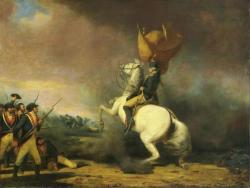 The British took shelter in and around Nassau Hall in Princeton. The Americans brought up a cannon, and took two shots at the building. The first bounced off, but the second entered the main room where the troops were holding, and allegedly decapitated a picture of King George the 2nd on the wall! The British in Nassau Hall surrendered.
 Jersey Girl Today