 Easter is the holiday that celebrates and commemorates the central event of the Christian faith: the resurrection of Jesus Christ three days after his death by crucifixion. All major branches of Christianity observe the holiday. Today, other than church attendance, the holiday often involves Easter Eggs for toys and candy as well as the imagery of bunnies and rabbits (see more below). Easter occurs the Sunday after Good Friday.
The resurrection of Jesus Christ is the centerpiece of the Christian faith, according to the Apostle Paul, who even says that if Jesus Christ has not been resurrected then the Christian faith is worthless and futile (1 Cor. 15:14-17). Therefore, without Easter there is no Christianity.
Easter is the oldest Christian holiday and the most important day of the church year. All the Christian movable feasts and the entire liturgical year of worship are arranged around Easter. Easter is preceded by the season of Lent, a 40-day period of fasting and repentance culminating in Holy Week, and followed by a 50-day Easter Season that stretches from Easter to Pentecost.
There is evidence that Christians originally celebrated the resurrection of Christ every Sunday, with observances such as Scripture readings, psalms, the Eucharist, and a prohibition against kneeling in prayer. {6} At some point in the first two centuries, however, it became customary to celebrate the resurrection specially on one day each year. Many of the religious observances of this celebration were taken from the Jewish Passover.
The specific day on which the resurrection should be celebrated became a major point of contention within the church. First, should it be on Jewish Passover no matter on what day that falls, or should it always fall on a Sunday? It seems Christians in Asia took the former position, while those everywhere else insisted on the latter. The eminent church fathers Irenaeus and Polycarp were among the Asiatic Christians, and they claimed the authority of St. John the Apostle for their position. Nevertheless, the church majority officially decided that Easter should always be celebrated on a Sunday. Eusebius of Caesarea, our only source on this topic, reports the affair as follows:
A question of no small importance arose at that time [c. 190 AD]. The dioceses of all Asia, as from an older tradition, held that the fourteenth day of the moon, on which day the Jews were commanded to sacrifice the lamb, should always be observed as the feast of the life-giving pasch, contending that the fast ought to end on that day, whatever day of the week it might happen to be. However it was not the custom of the churches in the rest of the world to end it at this point, as they observed the practice, which from Apostolic tradition has prevailed to the present time, of terminating the fast on no other day than on that of the Resurrection of our Saviour. Synods and assemblies of bishops were held on this account, and all with one consent through mutual correspondence drew up an ecclesiastical decree that the mystery of the Resurrection of the Lord should be celebrated on no other day but the Sunday and that we should observe the close of the paschal fast on that day only. {7} With this issue resolved, the next problem was to determine which Sunday to celebrate the resurrection. The Christians in Syria and Mesopotamia held their festival on the Sunday after the Jewish Passover (which itself varied a great deal), but those in Alexandria and other regions held it on the first Sunday after the spring equinox, without regard to the Passover.
This second issue was decided at the Council of Nicea in 325, which decreed that Easter should be celebrated by all on the same Sunday, which Sunday shall be the first following the paschal moon (and the paschal moon must not precede the spring equinox), and that a particular church should determine the date of Easter and communicate it throughout the empire (probably Alexandria, with their skill in astronomical calculations).
The policy was adopted throughout the empire, but Rome adopted an 84-year lunar cycle for determining the date, whereas Alexandria used a 19-year cycle. {8} Use of these different “paschal cycles” persists to this day and contributes to the disparity between the eastern and western dates of Easter.
Common elements found in most Roman Catholic, Eastern Orthodox, and Protestant religious Easter celebrations include baptism, the Eucharist, feasting, and greetings of “Christ is risen!” and “He is risen indeed!”
In Roman Catholicism, and some Lutheran and Anglican churches, Easter is celebrated with a vigil that consists of “the blessing of the new fire (a practice introduced during the early Middle Ages); the lighting of the paschal candle; a service of lessons, called the prophecies; followed by the blessing of the font and baptisms and then the mass of Easter.” {9} The traditional customs of the Catholic church are described in detail in the online Catholic Encyclopedia {10}.
In Orthodox churches, the vigil service is preceded by a procession outside the church. When the procession leaves the church, there are no lights on. The procession conducts a symbolic fruitless search for Christ’s body, then joyfully announces, “Christ is risen!” When the procession returns to the church, hundreds of candles and lamps are lit to symbolize the splendor of Christ’s resurrection, and the Easter Eucharist is taken. {11}
Protestant observances also include baptism and the Eucharist (or Lord’s Supper), and often a sunrise service (to commemorate Mary Magdalene’s arrival at the empty tomb “early, while it was still dark”) and special hymns and songs.
Easter Eggs and Christianity
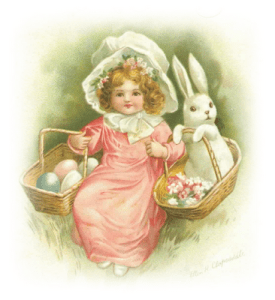 What do eggs have to do with Easter? Over the centuries, Easter Sunday has been supplemented by popular customs, many of were incorporated from springtime fertility celebrations of European and Middle Eastern pagan religion. Rabbits and eggs, for example, are widely-used pagan symbols for fertility.
Some Christians disassociate themselves entirely from Easter eggs because of their pagan connotations. Other Christians view Easter eggs, or other candies and treats, as symbols of joy and celebration (as they were forbidden during the fast of Lent) and as a “taste” of new life and resurrection that they have in Jesus Christ. A common custom is to hide brightly colored eggs for children to find.
ORIGNAL ARTICLE COURTESY OF RELIGION FACTS
 Jersey Girl Today