american citizens

Battle of Princeton (January 3, 1777)

‘Ten Crucial Days’, from Dec. 25th 1776 to Jan. 3rd 1777’

Prelude to the Battle:
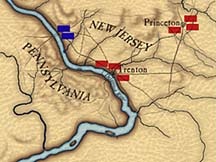
map_trentonMany Americans don’t realize that George Washington & his troops crossed and re-crossed the Delaware River a total of four times in the waning days of 1776. The first time was in early December when he left New Jersey in retreat from the British.

The second was when he crossed back into New Jersey to attack Trenton (Dec.25-26). After Trenton was taken, Washington thought it wise to put the river between his army and the more powerful British army, and so back they went back to Pennsylvania. When Washington arrived back at the Pennsylvania camp, he received word that Brigadier General Cadwalader had not crossed the river on Christmas due to the bad weather and mistakenly assumed that Washington would not have crossed either.

Upon learning that Washington had not only crossed but had beaten the Hessians, the shame-faced Cadwalader finally crossed and entered the unoccupied Trenton. Washington did not want to put a negative spin on the so far victorious venture by ordering Cadwalader to retreat, and so crossed the river once again and joined the two commands together on the 29th of December. By this time British General Cornwallis had arrived at Princeton, New Jersey with 8,000 troops. Washington knew he could expect an attack by Cornwallis very shortly and was determined to make a fight of it. Instead of fortifying Trenton, though he put his lines just south of the town on the south bank of the Assunpink Creek.

On Dec. 27th General Cadwalader, who had been unable to land on the Jersey shore on the 26th due to the ice on that shore, reported he was crossing near Burlington, reinforced by militia which was turning up encouraged by the victory. Cadwalader was unaware that Washington had re-crossed the river. He moved into the now empty Burlington and then to Bordentown, reporting that the citizens were hastily removing the red rags nailed to their doors as symbols of loyalty to the crown. He entreated Washington to join him in advancing on the British who were in a panic.

Washington’s troops were at the moment in no condition to advance, further, he was short of food. Moreover, many of his New England troop’s enlistments were due to expire on the 1st of Jan. By the 30th he had improved his supply situation and re-crossed the river. On the 30th he made an impassioned plea to a regiment whose enlistments were about to expire. No one stepped forth to stay. Once again Washington spoke “My brave fellows, you have done all I asked you to do and more than could reasonably be expected. But your country is at stake, your wives, your houses, and all that you hold dear. You have worn yourselves out with fatigues and hardships, but we know not how to spare you. If you will consent to stay only one month longer, you will render that service to the cause of liberty and to your country which you probably never can do under any other circumstances. The present is emphatically the crisis which is to decide our destiny.”

Again the drums rolled, calling for men to step forward, and finally about half the men step out to reenlist. Other officers speak to other regiments with the same success. With the other troops on hand, it will have to be enough. If Washington could maintain the initiative, he might save the Revolution. If he loses a battle at this critical time, it was thought the revolution would collapse.

The Battle of Princeton
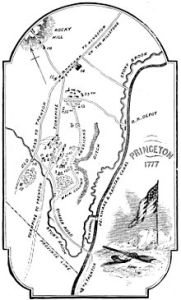
220px-Map_of_the_Battle_of_Princeton,_NJ_January_2-3,_1777British General Howe orders General Lord Cornwallis to Princeton to gather all available troops for a counter attack. On January 2nd, Cornwallis marches on Trenton with about 6000 men, leaving three regiments of the 4th Brigade at Princeton as rear-guard, under Colonel Charles Mawhood. At Maidenhead (now Lawrenceville) on Jan 2nd, the British meet with American units who begin a fighting withdrawal, ambushing and delaying the British. It is 4 PM when the British finally get to Trenton, to find Washington entrenched but out-numbered and outclassed. Washington has but 5,200 men, many unreliable militia. Washington has deployed his troops on the south side of Assunpink Creek, a strong position, and repels several attempts of the British to take the bridge. Night eventually fell. Since his troops are tired, Cornwallis decided to wait to attack until the morning, when he can “bag the fox” as he called it. His officers want to attack now, fearful of Washington’s known ability to retreat and escape but Cornwallis remained arrogantly steadfast believing that a mere rabble of farmers could never defeat British regulars.

During the night, Washington leaves a hand-full of his men to keep the campfires burning, make entrenchment noises, and keep up appearances, while the rest of the army sneaks around the British forces toward Princeton, where they can attack the rear of the British forces and maybe even capture the 70,000 pound sterling war treasury of General William Howe in New Brunswick. Washington orders his troops to silence and all orders are given in whispers. Taking back roads, the Americans move to the south around the British and swing towards Princeton. Main roads at this time are poor tracks-some of these back roads are little more than trails which had already become unused as the area was settled but the troops stagger along them in the dark all night. Luckily a freeze has set in with nightfall and the roads are frozen and unpassable for both men and cannon.

At dawn, Lt. Colonel Charles Mawhood has begun to follow in the wake of Cornwallis to Trenton, with his 17th Foot of the 250x167xbattle-of-princeton-wcpd_jpg_pagespeed_ic_lsJ-eaWBkx4th Brigade followed by the 55th, and the 40th regiment ordered to remain in Princeton. Now the Americans under General Hugh Mercer who had been sent to guard the left flank and the 17th under Mawhood discover each other at the same time, and move to attack. The 55th moves back into Princeton. Mercer and Mawhood each believe they have encountered a patrol. Mawhood has about 276 men, and Mercer 120 with 200 following. Both race to the high ground (now called Mercer heights). Mercer is surprised to run into Mawhood’s men deployed in line. Captain Willie Leslie of the 17th, and nephew of General Alexander Leslie, is killed in the first fire.
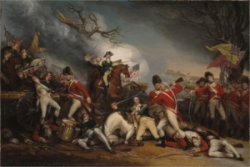
After exchanging fires, Mawhood’s regiment charges with the bayonet. Only 20 or so of Mercer’s men have muskets and bayonets, most being slow reloading riflemen whose guns cannot use bayonets. Mercer is mortally wounded and his troops fall back, but Cadwalader’s 600 men of the Pennsylvania militia arrive. They fire and then start to fall back, even though they greatly outnumber the 17th. (Mawhood and the 17th regiment put up a terrific defense, still remembered and honored in Great Britain.)

Washington and his officers rally them, and more troops arrive and Washington himself leads them towards the British. Washington is only 30 yards from the British lines when he orders his men to fire. Both sides do fire, and Washington disappears in the smoke. When the smoke clears Washington is unharmed but Mawhood’s regulars have broken. Washington orders a charge. The British troops retreat, some scattering into the woods, others turning for Cornwallis or New Brunswick. Washington also leads the pursuit, calling “It’s a fine fox hunt, boys!”

In Princeton, the 40th and 55th regiments prepared to make a defense of the town. General Sullivan had his wing of the army moving to sweep into town from the other end, and the British sent out a platoon to outflank them. Sullivan in turn sent out 2 regiments to counter this flanking maneuver, forcing the British back. Now Sullivan’s men met an equal number of British deployed behind a dike in the area of Frog hollow. Sullivan had his cannon brought up, which sent shot into the dike and drove the British into the area of Nassau hall, the main college building at the time.
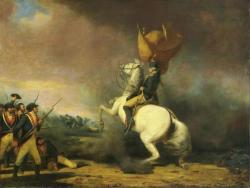
250x188xprinceton-washington-wcpd_jpg_pagespeed_ic_BhBEWJIwxuThe British took shelter in and around Nassau Hall in Princeton. The Americans brought up a cannon, and took two shots at the building. The first bounced off, but the second entered the main room where the troops were holding, and allegedly decapitated a picture of King George the 2nd on the wall! The British in Nassau Hall surrendered.

When the British Dragoons make a stand to defend the fleeing troops, Washington called off all pursuit. Washington knew that Cornwallis could move on his rear soon, and he had to keep the army together. Placing a militia unit to destroy the bridge over the Stony Brook, and gathering what supplies could be quickly loaded, he ordered his troops to march to Kingston. Here, it was decided that even though New Brunswick and the British treasury were only a few miles away, and lightly guarded, the exhausted troops could do no more for now. The American Army moved north along the Millstone River to Somerset Court House, now Millstone, where he had to rest his troops.

Back at Trenton on the 3rd, Cornwallis found that the Americans were gone by dawn and at first it was believed they had marched to Bordentown, but soon he received reports of fighting at Princeton and he marched toward Princeton. When his vanguard reached the Stony Brook they realized that bridge over the creek is broken up~ obviously destroyed by the Americans. The militia makes a short stand, forcing the British to stop and form for battle. Washington and the troops are able to get away, and Cornwallis rests his troops for a few hours.

At Kingston, Cornwallis heads for Brunswick and arrives at 6 AM where he deploys troops to defend the town. Washington is a few miles away at Somerset Court House (now Millstone), but his troops are exhausted, some have hardly eaten, and Cornwallis position was not known, except that he was close. Any attack is not considered possible.

On the 4th, after deciding not to attack New Brunswick, Washington continued north, and later that day they arrived in Pluckemin. Protected now by the Watchung Mountains to his east, and with Morristown units behind him, Washington was now safe. He would soon move the army into winter quarters at Morristown.

After The Battle:

The British, who lost 86 killed and wounded at Princeton and two hundred captured, were now ordered by Howe to abandon NJ, except for a line from Perth Amboy to New Brunswick. George Washington, who had about 40 killed and wounded at Princeton, had now driven the British from most of New Jersey, in what is called the ‘Ten Crucial Days’, from Dec. 25th 1776 to Jan. 3rd 1777.

More importantly, the Revolution now had a chance, morale was improved, and Americans once again believed they could stand and face the enemy troops. The British outrages in the invasion of New Jersey had turned many previously on the fence to the side of the revolution against the British. Paper money was acceptable once more and the rebel government and army found support again. General George Washington had learned to fight not the main British army, but its outposts which forced the British to give up any effort to control the environs of America. The French government, encouraged by the British defeats, released supplies to the American war effort. In England, the royal government started losing support for the war. The Crisis was past, even if severe hardship and fighting were yet ahead, in a long and bitter struggle for freedom and independence.

The Treaty of Paris was signed in Paris by representatives of King George III of Great Britain and representatives of the United States of America on September 3, 1783, thus ending the American Revolutionary War and recognizing the original 13 colonies (Delaware, Pennsylvania, New Jersey, Georgia, Connecticut, Massachusetts Bay, Maryland, South Carolina, New Hampshire, Virginia, New York, North Carolina, and Rhode Island  ) as a new and sovereign nation.  GOD BLESS AMERICA! ~ JGT


IF OBAMA CAN QUOTE SCRIPTURE~ I CAN TOO! (Repost)

As usual~ during my customary “END OF THE YEAR REVIEW OF EVERYTHING” I ran across this article originally posted in November 2014 and STILL find it appropriate! And so~ I’m re-posting it!~ JGT

Maybe it’s just me, but I really hate it when politicians quote scripture as a justification for their actions and/or policies. The other night, POTUS Barack Obama did exactly that on national television in order to TRY to justify his obvious attempt of trampling on the United States Constitution & to test the limits of presidential power in our country.  POTUS Obama (who, in my opinion, is his own worst enemy when it comes to transparency & telling the truth) had picked a quote from the Holy Bible which he included in his speech; but which one? No one seems to know which of the Christian Bible’s  31,173 verses that Obama was referring to? I think the quote Obama referred to may have been  from  Exodus 22:21; “We shall not oppress a stranger for we know the heart of a stranger — we were strangers once, too.” Was that  it; I wonder?  Regardless, as usual ~Obama read the words that scrolled down the presidential teleprompter just as stilted, unattached & as unaffected by his spoken words as usual & most likely without any thought~ never really made any kind of human or moral connection with what he was saying!

MY quote is also from the book of Exodus as read in the King James Bible~ Exodus 20:16 – “Thou shalt not bear false witness against thy neighbor.” To that end~ and as a Christian; I can only wish him, Good Luck on Judgment Day. HE is going to need it! 

As a Jersey Girl, US Navy Veteran & Baby Boomer I also offer the following quote from 1979’s song “Goodbye Stranger” by the group, Supertramp. ~JGT

“Goodbye stranger it’s been nice~  Hope you find your paradise.
Tried to see your point of view~  Hope your dreams will all come true!”

My Bible Quote for Sunday, November 23, 2014  comes from the Holy Bible ~ Matthew 25:31–46

Jesus said to his disciples:  “When the Son of Man comes in his glory, and all the angels with him, he will sit upon his glorious throne, and all the nations will be assembled before him. And he will separate them one from another, as a shepherd separates the sheep from the goats. He will place the sheep on his right and the goats on his left. Then the king will say to those on his right, ‘Come, you who are blessed by my Father. Inherit the kingdom prepared for you from the foundation of the world. For I was hungry and you gave me food, I was thirsty and you gave me drink, a stranger and you welcomed me, naked and you clothed me, ill and you cared for me, in prison and you visited me.’

Then the righteous will answer him and say, ‘Lord, when did we see you hungry and feed you, or thirsty and give you drink? When did we see you a stranger and welcome you, or naked and clothe you? When did we see you ill or in prison, and visit you?’ And the king will say to them in reply, ‘Amen, I say to you, whatever you did for one of the least brothers of mine, you did for me.’

Then he will say to those on his left, ‘Depart from me, you accursed, into the eternal fire prepared for the devil and his angels. For I was hungry and you gave me no food, I was thirsty and you gave me no drink, a stranger and you gave me no welcome, naked and you gave me no clothing, ill and in prison, and you did not care for me.’ Then they will answer and say, ‘Lord, when did we see you hungry or thirsty or a stranger or naked or ill or in prison, and not minister to your needs?’ He will answer them, ‘Amen, I say to you, what you did not do for one of these least ones, you did not do for me.’ And these will go off to eternal punishment, but the righteous to eternal life.”

HISTORY OF VETERAN’S DAY

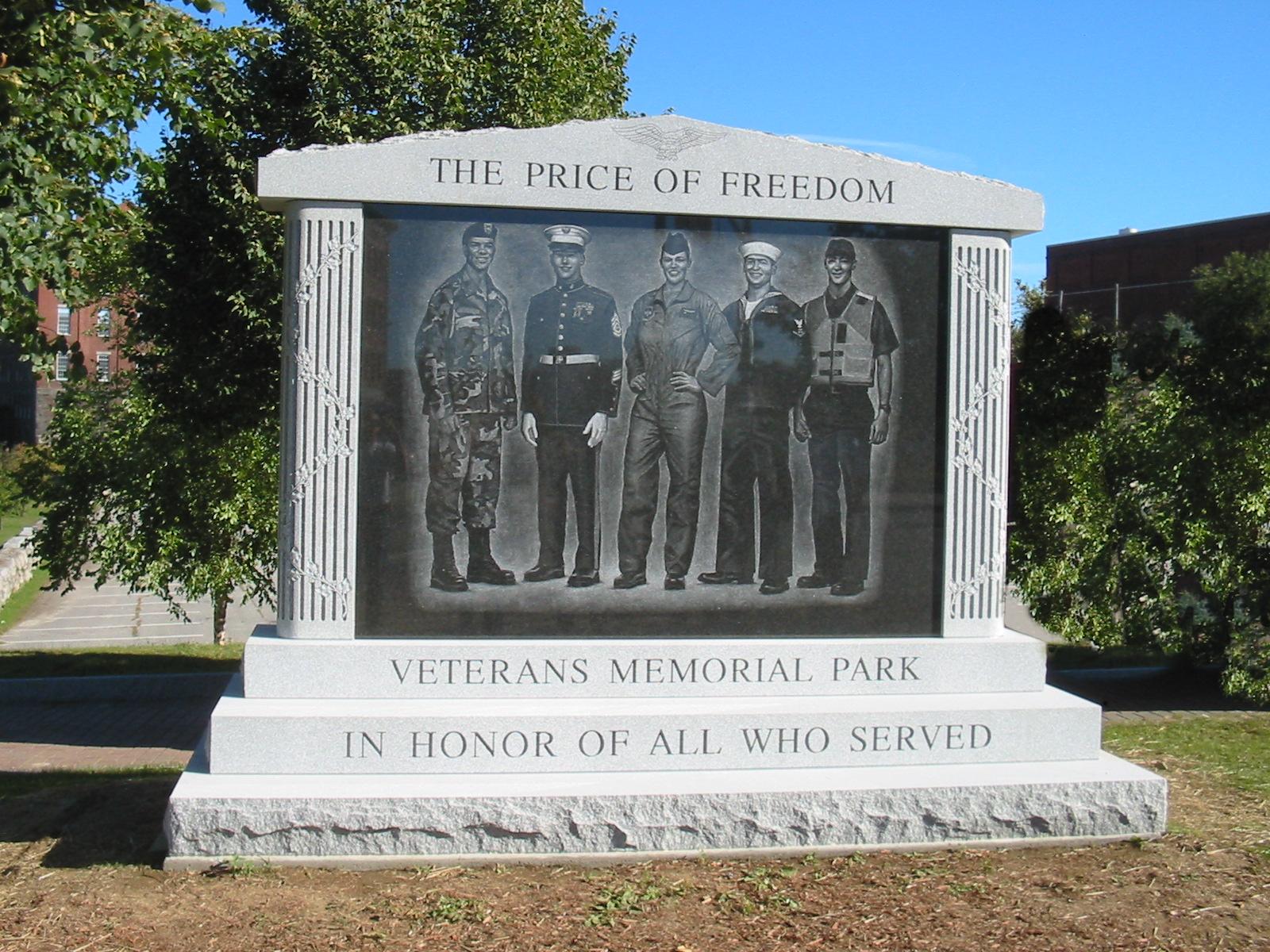
memorial%20parkWorld War I – known at the time as “The Great War” – officially ended when the Treaty of Versailles was signed on June 28, 1919, in the Palace of Versailles outside the town of Versailles, France. However, fighting ceased seven months earlier when an armistice, or temporary cessation of hostilities, between the Allied nations and Germany went into effect on the eleventh hour of the eleventh day of the eleventh month. For that reason, November 11, 1918, is generally regarded as the end of “the war to end all wars.”

Soldiers of the 353rd Infantry near a church at Stenay, Meuse in France, wait for the end of hostilities.  The Last Two Minutes of FightingThis photo was taken at 10:58 a.m., on November 11, 1918, two minutes before the armistice ending World War I went into effect

In November 1919, President Wilson proclaimed November 11 as the first commemoration of Armistice Day with the following words: “To us in America, the reflections of Armistice Day will be filled with solemn pride in the heroism of those who died in the country’s service and with gratitude for the victory, both because of the thing from which it has freed us and because of the opportunity it has given America to show her sympathy with peace and justice in the councils of the nations…”  The original concept for the celebration was for a day observed with parades and public meetings and a brief suspension of business beginning at 11:00 a.m.

The United States Congress officially recognized the end of World War I when it passed a concurrent resolution on June 4, 1926, with these words:

Whereas the 11th of November 1918, marked the cessation of the most destructive, sanguinary, and far reaching war in human annals and the resumption by the people of the United States of peaceful relations with other nations, which we hope may never again be severed, and

Whereas it is fitting that the recurring anniversary of this date should be commemorated with thanksgiving and prayer and exercises designed to perpetuate peace through good will and mutual understanding between nations; and

Whereas the legislatures of twenty-seven of our States have already declared November 11 to be a legal holiday: Therefore be it Resolved by the Senate (the House of Representatives concurring), that the President of the United States is requested to issue a proclamation calling upon the officials to display the flag of the United States on all Government buildings on November 11 and inviting the people of the United States to observe the day in schools and churches, or other suitable places, with appropriate ceremonies of friendly relations with all other peoples.

An Act (52 Stat. 351; 5 U. S. Code, Sec. 87a) approved May 13, 1938, made the 11th of November in each year a legal holiday—a day to be dedicated to the cause of world peace and to be thereafter celebrated and known as “Armistice Day.” Armistice Day was primarily a day set aside to honor veterans of World War I, but in 1954, after World War II had required the greatest mobilization of soldiers, sailors, Marines and airmen in the Nation’s history; after American forces had fought aggression in Korea, the 83rd Congress, at the urging of the veterans service organizations, amended the Act of 1938 by striking out the word “Armistice” and inserting in its place the word “Veterans.” With the approval of this legislation (Public Law 380) on June 1, 1954, November 11th became a day to honor American veterans of all wars.

Later that same year, on October 8th, President Dwight D. Eisenhower issued the first “Veterans Day Proclamation” which stated: “In order to insure proper and widespread observance of this anniversary, all veterans, all veterans’ organizations, and the entire citizenry will wish to join hands in the common purpose. Toward this end, I am designating the Administrator of Veterans’ Affairs as Chairman of a Veterans Day National Committee, which shall include such other persons as the Chairman may select, and which will coordinate at the national level necessary planning for the observance. I am also requesting the heads of all departments and agencies of the Executive branch of the

On that same day, President  Eisenhower sent a letter to the Honorable Harvey V. Higley, Administrator of Veterans’ Affairs (VA), designating him as Chairman of the Veterans Day National Committee.

In 1958, the White House advised VA’s General Counsel that the 1954 designation of the VA Administrator as Chairman of the Veterans Day National Committee applied to all subsequent VA Administrators. Since March 1989 when VA was elevated to a cabinet level department, the Secretary of Veterans Affairs has served as the committee’s chairman.

The Uniform Holiday Bill (Public Law 90-363 (82 Stat. 250)) was signed on June 28, 1968, and was intended to ensure three-day weekends for Federal employees by celebrating four national holidays on Mondays: Washington’s Birthday, Memorial Day, Veterans Day, and Columbus Day. It was thought that these extended weekends would encourage travel, recreational and cultural activities and stimulate greater industrial and commercial production. Many states did not agree with this decision and continued to celebrate the holidays on their original dates.

The first Veterans Day under the new law was observed with much confusion on October 25, 1971. It was quite apparent that the commemoration of this day was a matter of historic and patriotic significance to a great number of our citizens, and so on September 20th, 1975, President Gerald R. Ford signed Public Law 94-97 (89 Stat. 479), which returned the annual observance of Veterans Day to its original date of November 11, beginning in 1978. This action supported the desires of the overwhelming majority of state legislatures, all major veterans service organizations and the American people.

Veterans Day continues to be observed on November 11, regardless of what day of the week on which it falls. The restoration of the observance of Veterans Day to November 11th not only preserves the historical significance of the date, but helps focus attention on the important purpose of Veterans Day: “A celebration to honor America’s veterans for their patriotism, love of country, and willingness to serve and sacrifice for the common good. The US Government to assist the National Committee in every way possible.”

Original Article courtesy of http://www.va.gov/opa/vetsday/vetdayhistory.asp

A Note from this Jersey Girl:

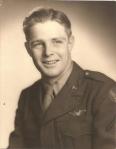
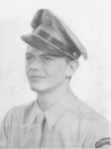
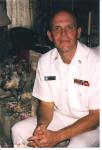
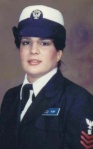
A heartfelt Thank You to my Father (Donald W. Flint, US Army Air Corps 1942 – 1945) and my Father-in Law (John Howard, US Army Rangers 3rd Battalion 1942- 1943 ) for your Patriotism & Sacrifices made during World War II. Your examples of honor & duty to country were eventually followed by your children, my husband & I when we joined the US Navy in the late 1970’s. However & Therefore; without sounding too self-serving, I’d like to thank you~both of my fathers~ for your Service to our country! (And you too, Luke!) ~JGT

DONALD W. FLINT USAF WWII 001Howard,_John_(website)RETIREMENT DAY 1999 001DoriNavy1stClass (4)

Military Facts and Legends: Legion of the United States

220px-American_Legion_1794When the 13 American Colonies initially began resisting Britain, they had no organized military. Individual states fielded militias and troops, but a unified military was lacking. In part, this was a result of wary attitudes among many members of the public who did not support the idea of an organized military force acting on behalf of all of the colonies. The Continental Congress also shared this view.

After a few defeats, however, the Continental Congress reluctantly established the Continental Army as a unified means for the colonies to fight Great Britain. Officially established on June 14, 1775, George Washington was named its commander in chief. But unconditional support was missing.  The Continental Congress came up with an inadequate and, in retrospect, foolish requirement where each of the then-colonies were to send men and to supply and pay those men. Since few colonies were able to meet these requirements, the Continental Army was often inadequately supplied with food, clothing, and other materials.

What was not lacking, however, was the spirit to succeed along with an interesting blend of traditional and well-established military tactics and innovations shown by members of the Continental Army. While it often struggled against the more highly trained and organized British troops in open battle, Continental forces were not above using guerrilla tactics to harry the British. It subverted traditional ideas about how wars should be fought, relying on knowledge of the terrain and creativity to fight the British, rather than attempting to overpower British forces by conventional means. Inconsistent organization within the British military forces was exploited by Continental troops.

Thought there were many defeats, there were also enough successes for the United States to win its bid for independence. After the signing of the Treaty of Paris in 1783 to end the Revolutionary War, the Founding Fathers, still suspicious of standing armies and believing that the militia would be suited to all the nation’s defensive needs, they disbanded the Continental Army. State militias became the new nation’s sole ground army, with the exception of a regiment to guard the Western Frontier and one battery of artillery guarding West Point’s arsenal.

However, because of continuing conflict with Native Americans, it was soon realized that it was necessary to field a trained standing army. The Regular Army was at first very small, and after General St. Clair’s defeat at the Battle of the Wabash, the Regular Army was reorganized in 1791 as the Legion of the United States.

St. Clair’s Defeat also known as the Battle of the Wabash, the Battle of Wabash River or the Battle of a Thousand Slain, was fought on November 4, 1791 in the Northwest Territory between the United States and the Western Confederacy of American Indians, as part of the Northwest Indian War. It was a major American Indian victory and remains the greatest defeat of the United States Army by American Indians; of the 1,000 officers and men that St. Clair led into battle, only 24 escaped unharmed.

The defeat of St. Clair, whose forces were drawn principally from state militias, caused a shift in thinking. President Washington picked his old lieutenant, General “Mad Anthony” Wayne, to lead a new professional army. At the recommendation of Secretary of War Henry Knox, it was decided to recruit and train a “Legion of the United States” that would combine all land combat arms of the day (cavalry, heavy and light infantry, artillery) into one efficient brigade-sized force divisible into stand-alone combined arms teams. Congress agreed with this proposal and agreed to augment the small standing army until “the United States shall be at peace with the Indian tribes.”

Eventually the need for a standing Army was realized by the congress and in 1789, the United States Army was established.

WHAT ARE POLICEMEN MADE OF?

WHAT ARE POLICEMEN MADE OF? By Paul Harvey~ August 27, 1966

Don’t credit me with the mongrel prose: It has many parents-at least 420,000 of them: Policemen.

A policeman is a composite of what all men are, mingling of a saint and sinner, dust and deity.

Gulled statistics wave the fan over the stinkers; underscore instances of dishonesty and brutality because they are “new”.  What they really mean is that they are exceptional, unusual, and not commonplace.

Buried under the frost is the fact: less than one-half of one percent of policemen misfit the uniform.  That’s a better average than you would find among clergy!

What is a policeman made of? He, of all men, is once the most needed and the most unwanted.  He’s a strangely nameless creature while it is “sir” to his face and “pig” or worse to his back.

He must be such a diplomat that he can settle differences between individuals so that each will think he won.

But…If the policeman is neat, he is conceited; If he’s careless, he’s a bum.  If he’s pleasant, he’s flirting; if not, he’s a grouch.

He must make an instant decision which would require months for a lawyer to make.

But…if he hurries, he’s careless; if he’s deliberate, he’s lazy.  He must be the first to an accident and be infallible with his diagnosis.  He must start breathing, stop bleeding, tie splints and above all, be sure the victim goes home without a limp, or expect to get sued.

The police officer must know every type of gun, draw on the run, and hit where it doesn’t hurt.  He must be able to whip two men twice his size and half his age without damaging his uniform and without being “brutal”.  If you hit him…he’s a coward.  If he hits you…he’s a bully.

A policeman must know everything-and not tell.  He must know where the sin is and not partake.

A policeman must from a single strand of hair, be able to describe the crime, the weapon and tell you who the criminal is and where he is hiding.

But…if he catches the criminal, he’s lucky; if he doesn’t, he is a dunce.  If he gets promoted, he has political pull; if he doesn’t, he is a dullard.  The policeman must chase a bum lead to a dead-end, stake out ten nights to tag one witness who saw it happen-but refused to remember.

The policeman must be a minister, a social worker, a diplomat, a tough guy and a gentleman.

And of course, he’d have to be a genius…for he will have to feed a family on a policeman’s salary.

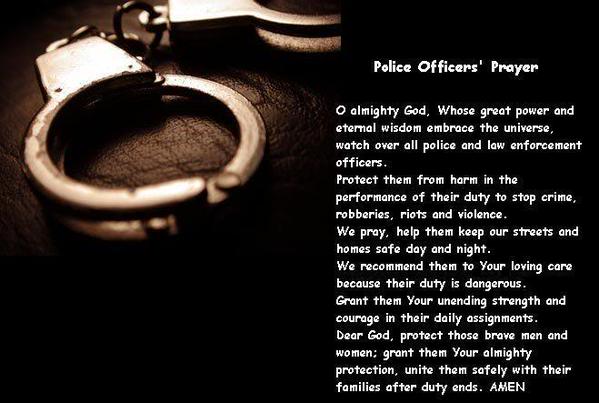
B5lpuabCMAIUErdPaul Harvey’s father was a Policeman killed in the line of duty in 1921 when Paul was only 3 years old. Here, he opined on the role of the police officer. God bless our Police, Firefighters and First Responders! ~JGT~


HOMELESS VETERANS ARE SNUBBED IN FAVOR OF ILLEGALS!

No Room for Vets in the Inn”  by Katie Kieffer,  Dec 22, 2014

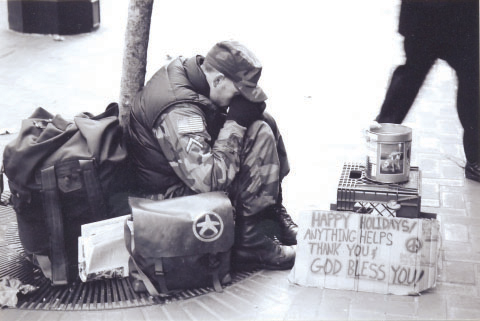
homeless-veteranHomeless American veterans shiver in the bitter cold while illegal immigrants receive subsidized four-year degrees. At midnight, in Bethlehem, in piercing cold, Christ was born in a stable after his parents were turned away by every innkeeper. Joseph and Mary did not respond with entitlement: “If you don’t shelter us, then you’re racist.” Rather, they used their ingenuity to find an alternative birthplace for their son among friends—farm animals, shepherds, kings, and angels—beneath the light of an extraordinary star.

“And she brought forth her firstborn son, and wrapped him up in swaddling clothes, and laid him in a manger; because there was no room for them in the inn.” Luke 2:7

Earlier this month, I spoke at American Legion Post 3 in Lincoln, NE. I was impressed by how veterans—many of them disabled or elderly—are actively working to serve homeless veterans in their community. The post commander distributed a long list of items including bath towels, silverware and blankets that he wanted help gathering for local homeless vets. Post 3 American Legion Riders and the Legionnaires were also planning monthly pancake breakfasts where homeless veterans could receive warm meals served by friendly faces.

Veterans who are active within the American Legion are working very hard to help their brothers and sisters who have served their country—only to find themselves on the streets. However, it is troubling to see that our federal government seems to be prioritizing aid for illegal immigrants over care for our homeless veterans.

American Legion National Commander Michael D. Helm has taken a firm stand against the current administration’s recent executive order, which will essentially grant amnesty to as many as 5 million illegal immigrants. On November 20, Helm wrote

“The American Legion urges the President in the strongest possible terms to put our security, and our citizens’ interests and wishes, ahead of providing amnesty for millions of immigrants here illegally. …we have reached out to the U.S. Citizenship and Immigration Services to offer our help in bringing immigrants to full citizenship. Rewarding illegal immigration is a slap in the face to those who have obeyed the law and patiently went through the process.”

Indeed, legal experts such as American Center for Law and Justice Chief Counsel Jay Sekulow call the President’s executive order “an unconstitutional power grab of historic proportions.” ArthurSchwab, federal judge in United States District Court for the Western District of Pennsylvania, authored a 38-page ruling last week showing that the President’s order violates the Constitution’s “Take Care” clause, which states: [The President] shall take care that the laws be faithfully executed….”

Article II, Section 3 of the Constitution mandates that the President enforce the laws. Only Congress, per the Constitution, may make laws. Since the executive order changes U.S. immigration law by decree of the President rather than through an act of Congress, it is unconstitutional.

Amnesty proponents often cite the economic contributions of illegal immigrants. Certainly, many illegal immigrants do backbreaking work. They have also broken our laws. Veterans, in contrast, served while risking their lives to defend our laws. Until every homeless veteran is in permanent housing, we should not be granting work permits and college financial aid packages to illegal immigrants.

Plus, here’s the dirty little secret: the current executive order is not about helping destitute people achieve the American Dream. It’s about buying votes. A careful read of a Dec. 14 New York Times article reveals that organizations fronting as advocacy groups are brainwashing illegal immigrants to abhor Republicans so as to secure millions of future votes for Democrats.

Immigration is a non-partisan issue, and Latinos should not be used as pawns for lobby groups, non-profits and crony capitalists. The current administration has used young people (Millennials), gays, blacks and women to win votes while abandoning and betraying our veterans like Lt. Clint Lorance and Sgt. Rob Richards. Now, the administration is using Latinos for votes.

Here’s the real humanitarian crisis: our political leadership has no respect for veterans. Veterans were denied access to the WWII, Vietnam and Korean War memorials in Washington, D.C.—while amnesty advocates were allowed on the National Mall and the state of California confiscated millions of taxpayer dollars to bankroll the education of illegal immigrants.

50,000 veterans will cope with homelessness every night this winter—while the President promises protection from deportation and work permits for up to 5 million illegal immigrants.

Away on a bleacher, no cot for a bed, a veteran lay down his sweet head. The stars in the bright sky looked down where he lay—in solidarity with the little Lord Jesus asleep in the hay.

In 2015, demand that your government make room for vets in America—“the inn” they fought so hard to defend.

Read the entire article at TownHall.com


President Ronald Reagan’s Thanksgiving Day Proclamation 1981

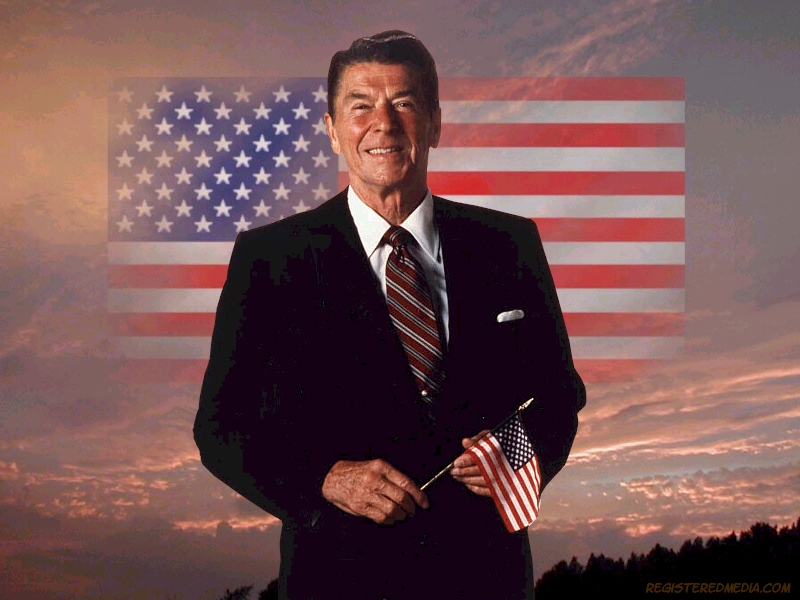
reagan2_largeAmerica has much for which to be thankful. The unequaled freedom enjoyed by our citizens has provided a harvest of plenty to this nation throughout its history. In keeping with America’s heritage, one day each year is set aside for giving thanks to god for all of His blessings. On this day of thanksgiving, it is appropriate that we recall the first thanksgiving, celebrated in the autumn of 1621. After surviving a bitter winter, the Pilgrims planted and harvested a bountiful crop. After the harvest they gathered their families together and joined in celebration and prayer with the Native Americans who had taught them so much. Clearly our forefathers were thankful not only for the material well being of their harvest but for this abundance of goodwill as well.

In this spirit, Thanksgiving has become a day when Americans extend a helping hand to the less fortunate. Long before there was a government welfare program, this spirit of voluntary giving was ingrained in the American character. Americans have always understood that, truly, one must give in order to receive. This should be a day of giving as well as a day of thanks. As we celebrate Thanksgiving in 1981, we should reflect on the full meaning of this day as we enjoy the fellowship that is so much a part of the holiday festivities. Searching our hearts, we should ask what we can do as individuals to demonstrate our gratitude to God for all He has done. Such reflection can only add to the significance of this precious day of remembrance.

Let us recommit ourselves to that devotion to God and family that has played such an important role in making this a great Nation, and which will be needed as a source of strength if we are to remain a great people. Now, Therefore, I, Ronald Reagan, President of the United States of America, do hereby proclaim Thursday, November 26, 1981, as Thanksgiving Day. In witness where of, I have here unto set my hand this twelfth day of November, in the year of our Lord nineteen hundred and eighty-one, and of the Independence of the United States of America the two hundred and sixth. ~ by Ronald Reagan, November 12, 1981.

HAPPY 239TH BIRTHDAY UNITED STATES NAVY

NAVY PRIDE RUNS DEEPOct. 13 marks the U.S. Navy’s 239th birthday. For many Sailors & Veterans the Navy’s birthday is a time to remember tradition and legacy. The U.S. Navy traces its origins to the Continental Navy, established by the Continental Congress, Oct. 13, 1775, by authorizing the procurement, fitting out, manning and dispatch of two armed vessels to cruise in search of munitions ships supplying the British Army in America.

In 1972, Chief of Naval Operations Admiral Elmo R. Zumwalt authorized recognition of Oct. 13 as the Navy Birthday, encouraging a Navy-wide celebration of this occasion, “to enhance a greater appreciation of our Navy heritage, and to provide a positive influence toward pride and professionalism in the naval service.”

The Birth of the Navy of the United States

On Friday, October 13, 1775, meeting in Philadelphia, the Continental Congress voted to fit out two sailing vessels, armed with ten carriage guns, as well as swivel guns, and manned by crews of eighty, and to send them out on a cruise of three months to intercept transports carrying munitions and stores to the British army in America. This was the original legislation out of which the Continental Navy grew and as such constitutes the birth certificate of the navy.

To understand the momentous significance of the decision to send two armed vessels to sea under the authority of the Continental Congress, we need to review the strategic situation in which it was made and to consider the political struggle that lay behind it.

Americans first took up arms in the spring of 1775, not to sever their relationship with the king, but to defend their rights within the British Empire. By the autumn of 1775, the British North American colonies from Maine to Georgia were in open rebellion. Royal governments had been thrust out of many colonial capitals and revolutionary governments put in their places. The Continental Congress had assumed some of the responsibilities of a central government for the colonies, created a Continental Army, issued paper money for the support of the troops, and formed a committee to negotiate with foreign countries. Continental forces captured Fort Ticonderoga on Lake Champlain and launched an invasion of Canada.

In October 1775 the British held superiority at sea, from which they threatened to stop up the colonies’ trade and to wreak destruction on seaside settlements. In response, a few of the states had commissioned small fleets of their own for defense of local waters. Congress had not yet authorized privateering. Some in Congress worried about pushing the armed struggle too far, hoping that reconciliation with the mother country was still possible.

Yet, a small coterie of men in Congress had been advocating a Continental Navy from the outset of armed hostilities. Foremost among these men was John Adams, of Massachusetts. For months, he and a few others had been agitating in Congress for the establishment of an American fleet. They argued that a fleet would defend the seacoast towns, protect vital trade, retaliate against British raiders, and make it possible to seek out among neutral nations of the world the arms and stores that would make resistance possible.

Still, the establishment of a navy seemed too bold a move for some of the timid men in Congress. Some southerners agreed that a fleet would protect and secure the trade of New England but denied that it would that of the southern colonies. Most of the delegates did not consider the break with England as final and feared that a navy implied sovereignty and independence. Others thought a navy a hasty and foolish challenge to the mightiest fleet the world had seen. The most the pro-navy men could do was to get Congress to urge each colony to fit out armed vessels for the protection of their coasts and harbors.

Then, on 3 October, Rhode Island’s delegates laid before Congress a bold resolution for the building and equipping of an American fleet, as soon as possible. When the motion came to the floor for debate, Samuel Chase, of Maryland, attacked it, saying it was “the maddest Idea in the World to think of building an American Fleet.” Even pro-navy members found the proposal too vague. It lacked specifics and no one could tell how much it would cost.

If Congress was yet unwilling to embrace the idea of establishing a navy as a permanent measure, it could be tempted by short-term opportunities. Fortuitously, on 5 October, Congress received intelligence of two English brigs, unarmed and without convoy, laden with munitions, leaving England bound for Quebec. Congress immediately appointed a committee to consider how to take advantage of this opportunity. Its members were all New Englanders and all ardent supporters of a navy. They recommended first that the governments of Massachusetts, Rhode Island, and Connecticut be asked to dispatch armed vessels to lay in wait to intercept the munitions ships; next they outlined a plan for the equipping by Congress of two armed vessels to cruise to the eastward to intercept any ships bearing supplies to the British army. Congress let this plan lie on the table until 13 October, when another fortuitous event occurred in favor of the naval movement. A letter from General Washington was read in Congress in which he reported that he had taken under his command, at Continental expense, three schooners to cruise off Massachusetts to intercept enemy supply ships. The commander in chief had preempted members of Congress reluctant to take the first step of fitting out warships under Continental authority. Since they already had armed vessels cruising in their name, it was not such a big step to approve two more. The committee’s proposal, now appearing eminently reasonable to the reluctant members, was adopted.

The Continental Navy grew into an important force. Within a few days, Congress established a Naval Committee charged with equipping a fleet. This committee directed the purchasing, outfitting, manning, and operations of the first ships of the new navy, drafted subsequent naval legislation, and prepared rules and regulations to govern the Continental Navy’s conduct and internal administration.

Over the course of the War of Independence, the Continental Navy sent to sea more than fifty armed vessels of various types. The navy’s squadrons and cruisers seized enemy supplies and carried correspondence and diplomats to Europe, returning with needed munitions. They took nearly 200 British vessels as prizes, some off the British Isles themselves, contributing to the demoralization of the enemy and forcing the British to divert warships to protect convoys and trade routes. In addition, the navy provoked diplomatic crises that helped bring France into the war against Great Britain. The Continental Navy began the proud tradition carried on today by our United States Navy, and whose birthday we celebrate each year in October.

Establishment of the Navy, 13 October 1775

This resolution of the Continental Congress marked the establishment of what is now the United States Navy.


Resolved, That a swift sailing vessel, to carry ten carriage guns, and a proportionable number of swivels, with eighty men, be fitted, with all possible despatch, for a cruise of three months, and that the commander be instructed to cruise eastward, for intercepting such transports as may be laden with warlike stores and other supplies for our enemies, and for such other purposes as the Congress shall direct.

That a Committee of three be appointed to prepare an estimate of the expence, and lay the same before the Congress, and to contract with proper persons to fit out the vessel.

Resolved, that another vessel be fitted out for the same purposes, and that the said committee report their opinion of a proper vessel, and also an estimate of the expence.”


Source: Journal of the Continental Congress, 13 October 1775, in William Bell Clark, editor, Naval Documents of the American Revolution, Vol. 2, (Washington, D.C.: Government Printing Office, 1966): 442.

th5D0OF9UM

Obama Administration Puts Public at Risk – Releases 36,000 Criminal Aliens

Article re-blogged from Judicial Watch (Obama Administration Puts Public at Risk – Releases 36,000 Criminal Aliens by Tom Fitton, President~ weekly Corruption Chronicles Blog Headlines October 3, 2014) ~JGT

When you’re living outside of Washington, D.C., and the word “criminal” is put in front of the phrase “illegal alien,” you may find that a bit redundant. But, to political insiders, it is simply typical Washington double-speak. And that may help explain why last year the Obama administration released 36,000 convicted illegal aliens on an unknowing American public. Each had been convicted of violent and other serious crime. To be clear, I’m talking about crimes such as murder, sexual assault, kidnapping and aggravated assault.  And, if you aren’t upset enough already, the criminal aliens who are now in circulation throughout the country have almost 88,000 convictions.

That’s why on July 21, 2014, your Judicial Watch filed a Freedom of Information Act (FOIA) lawsuit against the Department of Homeland Security (DHS) to obtain vital information about a report from our friends at the Center for Immigration Studies that found Immigration and Customs Enforcement (ICE) released 36,007 criminal aliens who were the subjects of deportation hearings. We filed our FOIA lawsuit after the DHS, which includes ICE, ignored our May 15, 2014, FOIA request for the following basic information:

Any and all records of communications including, but not limited to, emails to or from personnel in the office of the Principal Deputy Assistant Secretary of Immigration and Customs Enforcement (including its component offices, such as the Office of Public Affairs), from May 1 to May 15, 2014, concerning, regarding, or related to the report published by the Center for Immigrations Studies concerning the release of 36,000 criminal aliens.

A simple request designed to get to the heart of the decision that put untold innocents at risk – completely ignored by the misnamed Department of Homeland Security.  What agency dedicated to providing Americans “security” would release criminal aliens who should have been deported who had, collectively:

  • 193 homicide convictions (including one willful killing of a public official with gun)
  • 426 sexual assault convictions
  • 303 kidnapping convictions
  • 1,075 aggravated assault convictions
  • 1,160 stolen vehicle convictions
  • 9,187 dangerous drug convictions
  • 16,070 drunk or drugged driving convictions
  • 303 flight escape convictions

Immediately following the release of the CIS report, former House Judiciary Committee chairman Lamar Smith (R-TX) issued a statement terming the action, “the worst prison break in American history.” The representative laid the responsibility at the feet of President Obama, adding, “[I]t was sanctioned by the President and perpetrated by our own immigration officials … The Administration’s actions are outrageous. They willfully and knowingly put the interests of criminal immigrants before the safety and security of the American people.”

Obama administration officials, of course, took a far more casual attitude towards the “worst prison break in American history.” Three weeks after the release of the report, DHS Secretary Jeh Johnson told the Senate Judiciary Committee that he was he was still trying to understand what happened, and declined to provide further details as to how the criminal aliens were freed or who was responsible. Johnson told the committee, “I am aware of the reports that in Fiscal Year 2013 thousands of individuals with criminal convictions who may be removable were released from custody. I have asked for a deeper understanding of this issue.”

By the way, do you know why the Secret Service, also “run” by Mr. Johnson, would leave the front door of the White House open and allow the president to be put in an elevator with “security contractor with a gun and three convictions for assault and battery“?

According to documents obtained by Judicial Watch in May 2013, this is not be the first time Obama immigration policies have resulted in lax treatment of dangerous or potentially dangerous illegal aliens. The documents, obtained in accordance with an October 2012 FOIA request, revealed that the U.S. Citizenship and Immigration Services (USCIS) abandoned required background checks in 2012, adopting instead costly “lean and lite” procedures. The documents also revealed that, contrary to administration claims, that Obama’s Deferred Action for Childhood Arrivals (DACA) policies applied only to minors who came to this country illegally “through no fault of their own,” the directive actually created a new wave of chain migration, whereby immediate relatives of DACA requesters could be approved for amnesty. As a result, according to an agency memo from District 15 Director David Douglas, “some of the districts closer to the U.S./Mexico border have been inundated.”

The fact is, time and again, the Obama administration has rolled out the red carpet for illegal immigrants. And we now know that once they arrive, they are encouraged to stay, even if they have wreaked violent mayhem on the unsuspecting public. The American people deserve to have their own ‘deeper understanding’ of who authorized the release of these dangerous, convicted felons. And JW is going to court to find out.

In Washington, you get fired, and rightly so, for not doing your job and leaving the president unprotected.  But if you ignore the law and release criminals and guns onto the streets and get Americans killed, you get to be Attorney General, head of Homeland Security, and a seat behind the desk in the Oval Office.

For more info & other stories & opinions log to http://www.judicialwatch.org/blog/

WOO HOO! America’s first ‘MUSLIM FREE’ shooting range

After the Oklahoma beheading by a Muslim and ongoing threats from the Islamic State (ISIS), Arkansas Firing Range becomes the first to ban Muslims.

Bearing Arms  In an act that will no doubt result in lawsuits, The Gun Cave Indoor Shooting Range in Hot Springs, Arkansas, has declared itself a “Muslim free zone” due to concerns over domestic Islamic terrorism. The ban was announced yesterday by range owner Jan Morgan in an article posted to her web site where she cites ten points justifying her position.

Among the points cited are prior attacks in the United States that the federal government refuses to classify as terrorism, including the Fort Hood attack, the Boston Marathon bombing, and the last week’s Oklahoma City beheading. Morgan has also received death threats in the past for her writing about Islam.

Another incident that weighed heavily in Morgan’s decision was an incident at her firing range several weeks ago, which she relayed to Bearing Arms this morning.

Morgan claims that two Muslim men who spoke only broken English came to her range and requested to rent semi-automatic firearms and ammunition. One of them could not produce any identification showing that he was in the country legally, and the other had a California driver’s license. Neither had any apparent firearms training. She allowed them to rent one firearm, and stood behind them the entire time they were on the range, her hand on or near her holstered Glock 19. All other patrons voluntarily vacated the firing line while they were shooting.

She brings up a very valid point that gun stores and ranges have both a legal and moral obligation to ensure the safety of their patrons. Because of this, they may refuse service to anyone they deem to be under the influence, mentally unstable, or otherwise a potential threat to themselves, or others. FFLs are afforded a great deal of latitude in this regard, as the federal government would rather err on the side of caution.

While FFls and range operators have a great deal of latitude in their business dealings, it is doubtful that a blanket ban based upon religion is remotely viable on First Amendment grounds. This is no more legally viable than a ban on Baptists or Catholics.

Morgan expects that she will be sued over the decision for civil rights violations, and is gearing up for a court battle.


WOO HOO! America’s first ‘MUSLIM FREE’ shooting range.