Glad to read about the additional contribution by the U.S. Navy’s Construction Battalion. (SeaBees).
Author: jerseygirltoday
CANINE INFLUENZA ALERT 2015
 You may already be aware of a reported outbreak of dog flu/canine influenza in the Chicago area, with a few reported cases in Wisconsin and Indiana. I don’t wish to cause alarm, but I consider this an important situation for dog owners which calls for some extra awareness and attention. Canine influenza (CI), or dog flu, is caused by an influenza A virus. Originally believed to be a strain of the H3N8 canine influenza identified in the U.S. dog population in 2004, this virus is now considered closely related to Asian strains of influenza A H3N2 viruses. Although it does not infect people, it’s highly contagious to other dogs and can occur year round. Most dogs recover within 2-3 weeks; however, some fatal cases of pneumonia resulting from CI have been reported. Exposure to the virus comes from other dogs, in situations such as boarding, dog parks, or other activities where contact with respiratory secretions may occur. If the New Jersey area becomes affected, I will update this page ASAP. Meanwhile, for prevention I recommend temporarily limiting those activities that expose your dog to others. If your dog is exhibiting any of the following signs, please contact us immediately: You may already be aware of a reported outbreak of dog flu/canine influenza in the Chicago area, with a few reported cases in Wisconsin and Indiana. I don’t wish to cause alarm, but I consider this an important situation for dog owners which calls for some extra awareness and attention. Canine influenza (CI), or dog flu, is caused by an influenza A virus. Originally believed to be a strain of the H3N8 canine influenza identified in the U.S. dog population in 2004, this virus is now considered closely related to Asian strains of influenza A H3N2 viruses. Although it does not infect people, it’s highly contagious to other dogs and can occur year round. Most dogs recover within 2-3 weeks; however, some fatal cases of pneumonia resulting from CI have been reported. Exposure to the virus comes from other dogs, in situations such as boarding, dog parks, or other activities where contact with respiratory secretions may occur. If the New Jersey area becomes affected, I will update this page ASAP. Meanwhile, for prevention I recommend temporarily limiting those activities that expose your dog to others. If your dog is exhibiting any of the following signs, please contact us immediately:
It’s also worth noting that the H3N2 virus has caused infection and respiratory illness in cats, so if your cat goes outside or socializes with cats who do, keep an eye out for these signs, as well. These resources provide some more detailed information: |
Military Facts and Legends: Legion of the United States
 When the 13 American Colonies initially began resisting Britain, they had no organized military. Individual states fielded militias and troops, but a unified military was lacking. In part, this was a result of wary attitudes among many members of the public who did not support the idea of an organized military force acting on behalf of all of the colonies. The Continental Congress also shared this view.
After a few defeats, however, the Continental Congress reluctantly established the Continental Army as a unified means for the colonies to fight Great Britain. Officially established on June 14, 1775, George Washington was named its commander in chief. But unconditional support was missing. The Continental Congress came up with an inadequate and, in retrospect, foolish requirement where each of the then-colonies were to send men and to supply and pay those men. Since few colonies were able to meet these requirements, the Continental Army was often inadequately supplied with food, clothing, and other materials.
What was not lacking, however, was the spirit to succeed along with an interesting blend of traditional and well-established military tactics and innovations shown by members of the Continental Army. While it often struggled against the more highly trained and organized British troops in open battle, Continental forces were not above using guerrilla tactics to harry the British. It subverted traditional ideas about how wars should be fought, relying on knowledge of the terrain and creativity to fight the British, rather than attempting to overpower British forces by conventional means. Inconsistent organization within the British military forces was exploited by Continental troops.
Thought there were many defeats, there were also enough successes for the United States to win its bid for independence. After the signing of the Treaty of Paris in 1783 to end the Revolutionary War, the Founding Fathers, still suspicious of standing armies and believing that the militia would be suited to all the nation’s defensive needs, they disbanded the Continental Army. State militias became the new nation’s sole ground army, with the exception of a regiment to guard the Western Frontier and one battery of artillery guarding West Point’s arsenal.
However, because of continuing conflict with Native Americans, it was soon realized that it was necessary to field a trained standing army. The Regular Army was at first very small, and after General St. Clair’s defeat at the Battle of the Wabash, the Regular Army was reorganized in 1791 as the Legion of the United States.
St. Clair’s Defeat also known as the Battle of the Wabash, the Battle of Wabash River or the Battle of a Thousand Slain, was fought on November 4, 1791 in the Northwest Territory between the United States and the Western Confederacy of American Indians, as part of the Northwest Indian War. It was a major American Indian victory and remains the greatest defeat of the United States Army by American Indians; of the 1,000 officers and men that St. Clair led into battle, only 24 escaped unharmed.
The defeat of St. Clair, whose forces were drawn principally from state militias, caused a shift in thinking. President Washington picked his old lieutenant, General “Mad Anthony” Wayne, to lead a new professional army. At the recommendation of Secretary of War Henry Knox, it was decided to recruit and train a “Legion of the United States” that would combine all land combat arms of the day (cavalry, heavy and light infantry, artillery) into one efficient brigade-sized force divisible into stand-alone combined arms teams. Congress agreed with this proposal and agreed to augment the small standing army until “the United States shall be at peace with the Indian tribes.”
Eventually the need for a standing Army was realized by the congress and in 1789, the United States Army was established.
WISDOM OF CHILDREN
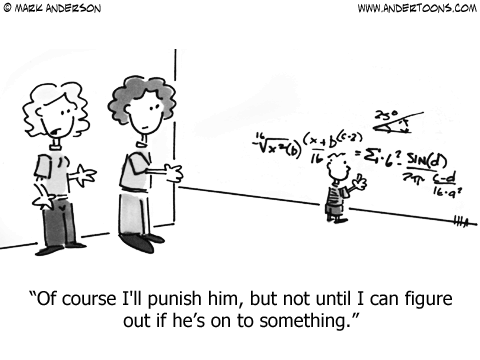 A first grade teacher was having trouble with one of her 6-year-old students. One day, she asked Johnny what his problem with her class was and he replied; “I’m too smart for the first grade. My sister is in the third grade and I’m smarter than she is too”! The teacher’s response was to immediately take little Johnny to the principal’s office.
After listening to the teacher carefully, the principal told her that he would give Johnny an oral test and that if he failed to answer any question correctly, he will go right back to the first grade & be quiet. Satisfied, the teacher and Johnny both agreed.
Principal; “How much is 3 X 3?”
Johnny; “9”
Principal; “And how much is 6 X 6”?
Johnny; “36”
It went on like that for quite some time and for every single question the principal asked, Johnny answered correctly. Finally, after about an hour the principal told the teacher; “I see no reason Johnny should stay in the first grade when it is obvious that he should be in the third grade. I’ll start the paperwork right away”.
The teacher quickly asked him if she could ask Johnny further questions. The principal and Johnny both agreed.
Teacher; “What does a cow have 4 of that I have only 2 of?”
Johnny; “Legs.”
Teacher; “What do you have in your pants that I don’t have?” The principal gasped~ but before he could stop Johnny from answering, Johnny says; “Pockets.”
Teacher; “What does a dog do that a man steps into?”
Johnny; “Pants.”
Teacher; “What starts with ‘F’, ends with ‘K’ and means a lot of excitement?”
Johnny; “Firetruck.”
The teacher’s jaw dropped and the principal breathed a big sigh of relief before quickly telling the teacher; “Put Johnny in the Fifth grade! I just got the last 4 questions wrong, myself!!!”
Indeed, Definitely smarter than Common Core! ~JGT
THE CHRISTMAS TRUCE OF 1914
The Christmas Truce of 1914
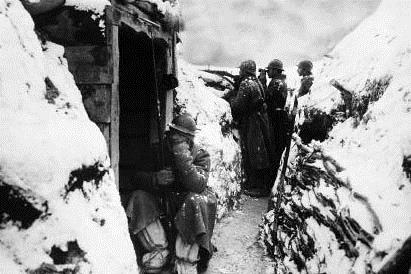 During World War I, in the bitter winter of 1914, on the battlefields of Flanders, one of the most unusual events in all of human history took place. The Germans had been in a fierce battle with the British and French. Both sides were dug in, safe in muddy, man-made trenches six to eight feet deep that seemed to stretch forever.
All of a sudden, German troops began to put small Christmas trees, lit with candles, outside of their trenches. Then, they began to sing songs. Across the way, in the “no man’s land” between them, came songs from the British and French troops. Incredibly, many of the Germans, who had worked in England before the war, were able to speak good enough English to propose a “Christmas” truce.
A spontaneous truce resulted. Soldiers left their trenches, meeting in the middle in fortified 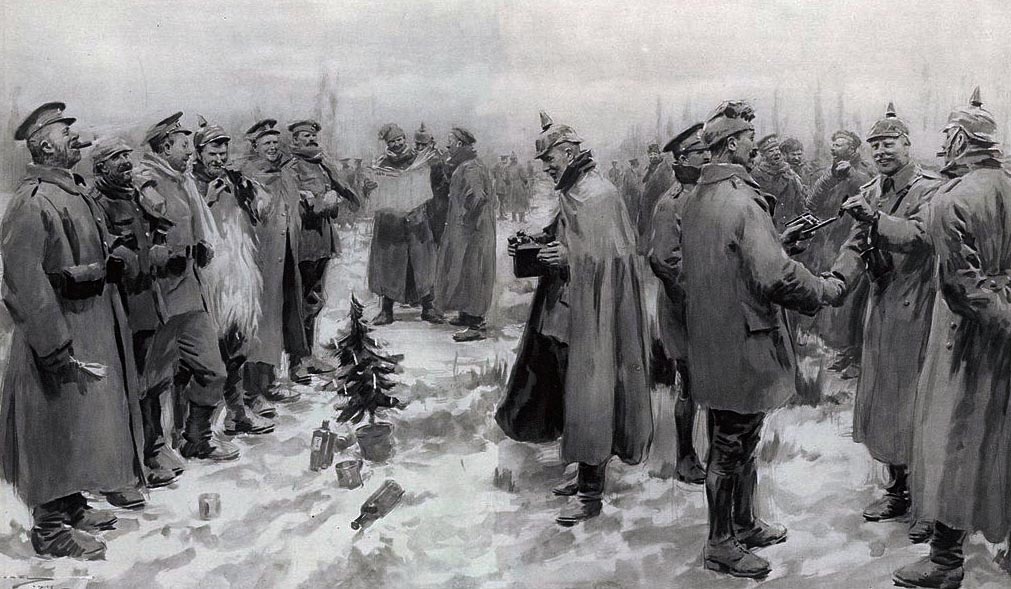 trenches to shake hands. The first order of business was to bury the dead who had been previously unreachable because of the conflict. Then, they exchanged gifts. Chocolate cake, cognac, postcards, newspapers, tobacco. In a few places, along the trenches, soldiers exchanged rifles for soccer balls and began to play soccer in the snow.
According to Stanley Weintraub, who wrote about this event in his book, “Silent Night”, “Signboards arose up and down the trenches in a variety of shapes. They were usually in English, or – from the Germans – in fractured English. Rightly, the Germans assumed that the other side could not read traditional gothic lettering, and that few English understood 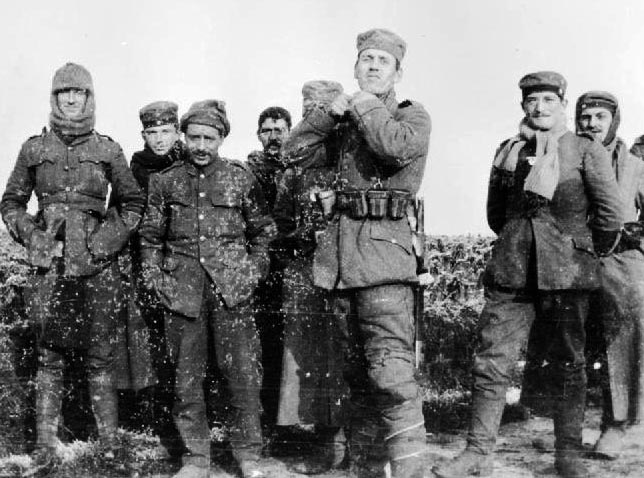 spoken German. ‘YOU NO FIGHT, WE NO FIGHT’ was the most frequently employed German message. Some British units improvised ‘MERRY CHRISTMAS’ banners and waited for a response. More placards on both sides popped up.”
Rare photo shows German soldiers of the 134th Saxon Regiment and British soldiers of the Royal Warwickshire Regiment meeting in “no man’s land” on December 26, 1914.
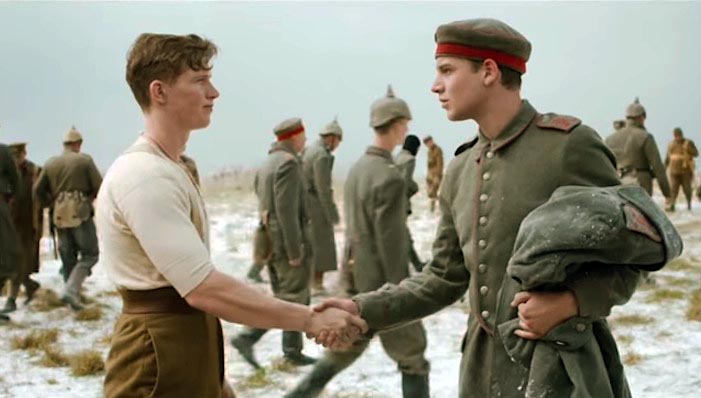
Reenactment on You Tube at: https://www.youtube.com/watch?v=NWF2JBb1bvM
It truce didn’t last forever. In fact, some of the generals didn’t like it at all and commanded their troops to resume shooting at each other. After all, they were in a war. Soldiers eventually did resume shooting at each other. But for a few precious moments there was peace on earth good will toward men. There’s something about Christmas that changes people. It happened over 2000 years ago in a little town called Bethlehem. It’s been happening over and over again down through the years of time.
Although the Christmas Truce of 1914 may seem like a distant myth to those now at arms in parts of the world where vast cultural differences between combatants make such an occurrence impossible, it remains a symbol of hope to those who believe that a recognition of our common humanity may someday reverse the maxim that “Peace is harder to make than war.”
Photos: From The Illustrated London News of January 9, 1915: “British and German Soldiers Arm-in-Arm Exchanging Headgear: A Christmas Truce between Opposing Trenches”
A cross, left in Saint-Yves (Saint-Yvon – Ploegsteert; Comines-Warneton in Belgium) in 1999, to commemorate the site of the Christmas Truce. The text reads: “1914 – The Khaki Chum’s Christmas Truce – 1999 – 85 Years “Lest We Forget”
German soldiers of the 134th Saxon Regiment and British soldiers of the Royal Warwickshire Regiment meet in no man’s land, December 26th.
WHAT ARE POLICEMEN MADE OF?
WHAT ARE POLICEMEN MADE OF? By Paul Harvey~ August 27, 1966
Don’t credit me with the mongrel prose: It has many parents-at least 420,000 of them: Policemen.
A policeman is a composite of what all men are, mingling of a saint and sinner, dust and deity.
Gulled statistics wave the fan over the stinkers; underscore instances of dishonesty and brutality because they are “new”. What they really mean is that they are exceptional, unusual, and not commonplace.
Buried under the frost is the fact: less than one-half of one percent of policemen misfit the uniform. That’s a better average than you would find among clergy!
What is a policeman made of? He, of all men, is once the most needed and the most unwanted. He’s a strangely nameless creature while it is “sir” to his face and “pig” or worse to his back.
He must be such a diplomat that he can settle differences between individuals so that each will think he won.
But…If the policeman is neat, he is conceited; If he’s careless, he’s a bum. If he’s pleasant, he’s flirting; if not, he’s a grouch.
He must make an instant decision which would require months for a lawyer to make.
But…if he hurries, he’s careless; if he’s deliberate, he’s lazy. He must be the first to an accident and be infallible with his diagnosis. He must start breathing, stop bleeding, tie splints and above all, be sure the victim goes home without a limp, or expect to get sued.
The police officer must know every type of gun, draw on the run, and hit where it doesn’t hurt. He must be able to whip two men twice his size and half his age without damaging his uniform and without being “brutal”. If you hit him…he’s a coward. If he hits you…he’s a bully.
A policeman must know everything-and not tell. He must know where the sin is and not partake.
A policeman must from a single strand of hair, be able to describe the crime, the weapon and tell you who the criminal is and where he is hiding.
But…if he catches the criminal, he’s lucky; if he doesn’t, he is a dunce. If he gets promoted, he has political pull; if he doesn’t, he is a dullard. The policeman must chase a bum lead to a dead-end, stake out ten nights to tag one witness who saw it happen-but refused to remember.
The policeman must be a minister, a social worker, a diplomat, a tough guy and a gentleman.
And of course, he’d have to be a genius…for he will have to feed a family on a policeman’s salary.
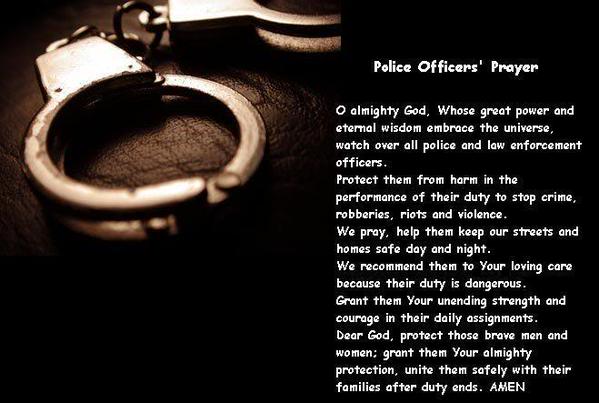 Paul Harvey’s father was a Policeman killed in the line of duty in 1921 when Paul was only 3 years old. Here, he opined on the role of the police officer. God bless our Police, Firefighters and First Responders! ~JGT~
HOMELESS VETERANS ARE SNUBBED IN FAVOR OF ILLEGALS!
“No Room for Vets in the Inn” by Katie Kieffer, Dec 22, 2014
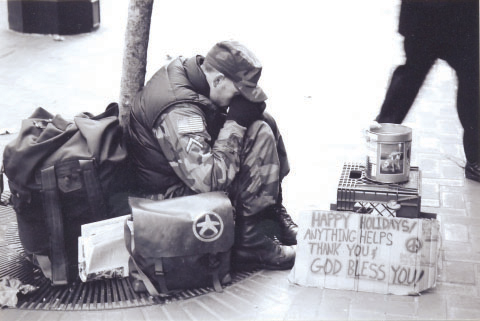 Homeless American veterans shiver in the bitter cold while illegal immigrants receive subsidized four-year degrees. At midnight, in Bethlehem, in piercing cold, Christ was born in a stable after his parents were turned away by every innkeeper. Joseph and Mary did not respond with entitlement: “If you don’t shelter us, then you’re racist.” Rather, they used their ingenuity to find an alternative birthplace for their son among friends—farm animals, shepherds, kings, and angels—beneath the light of an extraordinary star.
“And she brought forth her firstborn son, and wrapped him up in swaddling clothes, and laid him in a manger; because there was no room for them in the inn.” Luke 2:7
Earlier this month, I spoke at American Legion Post 3 in Lincoln, NE. I was impressed by how veterans—many of them disabled or elderly—are actively working to serve homeless veterans in their community. The post commander distributed a long list of items including bath towels, silverware and blankets that he wanted help gathering for local homeless vets. Post 3 American Legion Riders and the Legionnaires were also planning monthly pancake breakfasts where homeless veterans could receive warm meals served by friendly faces.
Veterans who are active within the American Legion are working very hard to help their brothers and sisters who have served their country—only to find themselves on the streets. However, it is troubling to see that our federal government seems to be prioritizing aid for illegal immigrants over care for our homeless veterans.
American Legion National Commander Michael D. Helm has taken a firm stand against the current administration’s recent executive order, which will essentially grant amnesty to as many as 5 million illegal immigrants. On November 20, Helm wrote:
“The American Legion urges the President in the strongest possible terms to put our security, and our citizens’ interests and wishes, ahead of providing amnesty for millions of immigrants here illegally. …we have reached out to the U.S. Citizenship and Immigration Services to offer our help in bringing immigrants to full citizenship. Rewarding illegal immigration is a slap in the face to those who have obeyed the law and patiently went through the process.”
Indeed, legal experts such as American Center for Law and Justice Chief Counsel Jay Sekulow call the President’s executive order “an unconstitutional power grab of historic proportions.” ArthurSchwab, federal judge in United States District Court for the Western District of Pennsylvania, authored a 38-page ruling last week showing that the President’s order violates the Constitution’s “Take Care” clause, which states: [The President] shall take care that the laws be faithfully executed….”
Article II, Section 3 of the Constitution mandates that the President enforce the laws. Only Congress, per the Constitution, may make laws. Since the executive order changes U.S. immigration law by decree of the President rather than through an act of Congress, it is unconstitutional.
Amnesty proponents often cite the economic contributions of illegal immigrants. Certainly, many illegal immigrants do backbreaking work. They have also broken our laws. Veterans, in contrast, served while risking their lives to defend our laws. Until every homeless veteran is in permanent housing, we should not be granting work permits and college financial aid packages to illegal immigrants.
Plus, here’s the dirty little secret: the current executive order is not about helping destitute people achieve the American Dream. It’s about buying votes. A careful read of a Dec. 14 New York Times article reveals that organizations fronting as advocacy groups are brainwashing illegal immigrants to abhor Republicans so as to secure millions of future votes for Democrats.
Immigration is a non-partisan issue, and Latinos should not be used as pawns for lobby groups, non-profits and crony capitalists. The current administration has used young people (Millennials), gays, blacks and women to win votes while abandoning and betraying our veterans like Lt. Clint Lorance and Sgt. Rob Richards. Now, the administration is using Latinos for votes.
Here’s the real humanitarian crisis: our political leadership has no respect for veterans. Veterans were denied access to the WWII, Vietnam and Korean War memorials in Washington, D.C.—while amnesty advocates were allowed on the National Mall and the state of California confiscated millions of taxpayer dollars to bankroll the education of illegal immigrants.
50,000 veterans will cope with homelessness every night this winter—while the President promises protection from deportation and work permits for up to 5 million illegal immigrants.
Away on a bleacher, no cot for a bed, a veteran lay down his sweet head. The stars in the bright sky looked down where he lay—in solidarity with the little Lord Jesus asleep in the hay.
In 2015, demand that your government make room for vets in America—“the inn” they fought so hard to defend.
Read the entire article at TownHall.com
GQ magazine names Obama as one of “least influential” people of 2014
I always believed Obama was full of crap & GQ magazine has confirmed him on their Least Influential List of 2014 in the #2 spot!
President Ronald Reagan’s Thanksgiving Day Proclamation 1981
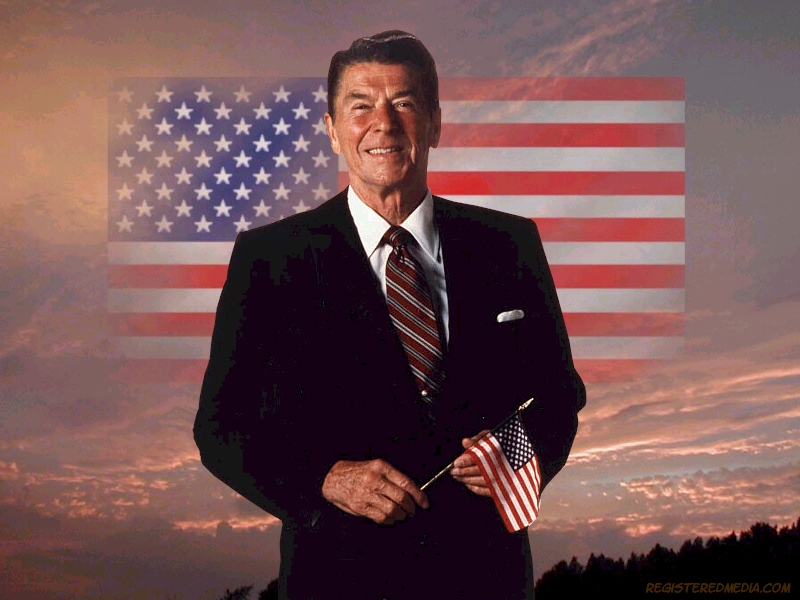 America has much for which to be thankful. The unequaled freedom enjoyed by our citizens has provided a harvest of plenty to this nation throughout its history. In keeping with America’s heritage, one day each year is set aside for giving thanks to god for all of His blessings. On this day of thanksgiving, it is appropriate that we recall the first thanksgiving, celebrated in the autumn of 1621. After surviving a bitter winter, the Pilgrims planted and harvested a bountiful crop. After the harvest they gathered their families together and joined in celebration and prayer with the Native Americans who had taught them so much. Clearly our forefathers were thankful not only for the material well being of their harvest but for this abundance of goodwill as well.
In this spirit, Thanksgiving has become a day when Americans extend a helping hand to the less fortunate. Long before there was a government welfare program, this spirit of voluntary giving was ingrained in the American character. Americans have always understood that, truly, one must give in order to receive. This should be a day of giving as well as a day of thanks. As we celebrate Thanksgiving in 1981, we should reflect on the full meaning of this day as we enjoy the fellowship that is so much a part of the holiday festivities. Searching our hearts, we should ask what we can do as individuals to demonstrate our gratitude to God for all He has done. Such reflection can only add to the significance of this precious day of remembrance.
Let us recommit ourselves to that devotion to God and family that has played such an important role in making this a great Nation, and which will be needed as a source of strength if we are to remain a great people. Now, Therefore, I, Ronald Reagan, President of the United States of America, do hereby proclaim Thursday, November 26, 1981, as Thanksgiving Day. In witness where of, I have here unto set my hand this twelfth day of November, in the year of our Lord nineteen hundred and eighty-one, and of the Independence of the United States of America the two hundred and sixth. ~ by Ronald Reagan, November 12, 1981.
HAPPY 239TH BIRTHDAY UNITED STATES NAVY
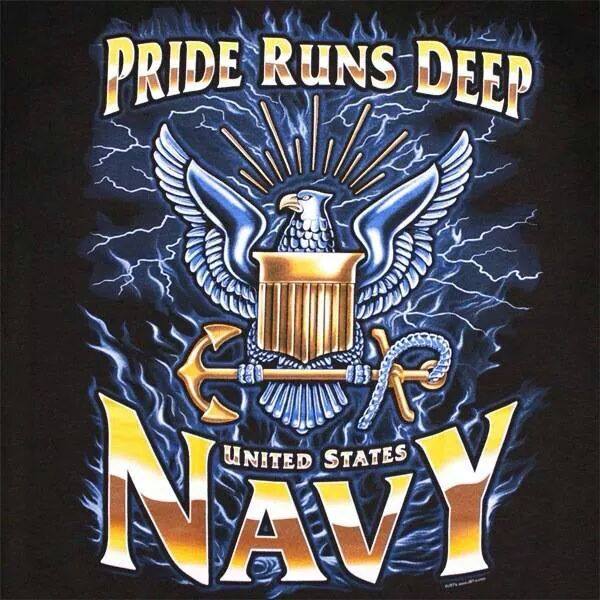 Oct. 13 marks the U.S. Navy’s 239th birthday. For many Sailors & Veterans the Navy’s birthday is a time to remember tradition and legacy. The U.S. Navy traces its origins to the Continental Navy, established by the Continental Congress, Oct. 13, 1775, by authorizing the procurement, fitting out, manning and dispatch of two armed vessels to cruise in search of munitions ships supplying the British Army in America.
In 1972, Chief of Naval Operations Admiral Elmo R. Zumwalt authorized recognition of Oct. 13 as the Navy Birthday, encouraging a Navy-wide celebration of this occasion, “to enhance a greater appreciation of our Navy heritage, and to provide a positive influence toward pride and professionalism in the naval service.”
The Birth of the Navy of the United States
On Friday, October 13, 1775, meeting in Philadelphia, the Continental Congress voted to fit out two sailing vessels, armed with ten carriage guns, as well as swivel guns, and manned by crews of eighty, and to send them out on a cruise of three months to intercept transports carrying munitions and stores to the British army in America. This was the original legislation out of which the Continental Navy grew and as such constitutes the birth certificate of the navy.
To understand the momentous significance of the decision to send two armed vessels to sea under the authority of the Continental Congress, we need to review the strategic situation in which it was made and to consider the political struggle that lay behind it.
Americans first took up arms in the spring of 1775, not to sever their relationship with the king, but to defend their rights within the British Empire. By the autumn of 1775, the British North American colonies from Maine to Georgia were in open rebellion. Royal governments had been thrust out of many colonial capitals and revolutionary governments put in their places. The Continental Congress had assumed some of the responsibilities of a central government for the colonies, created a Continental Army, issued paper money for the support of the troops, and formed a committee to negotiate with foreign countries. Continental forces captured Fort Ticonderoga on Lake Champlain and launched an invasion of Canada.
In October 1775 the British held superiority at sea, from which they threatened to stop up the colonies’ trade and to wreak destruction on seaside settlements. In response, a few of the states had commissioned small fleets of their own for defense of local waters. Congress had not yet authorized privateering. Some in Congress worried about pushing the armed struggle too far, hoping that reconciliation with the mother country was still possible.
Yet, a small coterie of men in Congress had been advocating a Continental Navy from the outset of armed hostilities. Foremost among these men was John Adams, of Massachusetts. For months, he and a few others had been agitating in Congress for the establishment of an American fleet. They argued that a fleet would defend the seacoast towns, protect vital trade, retaliate against British raiders, and make it possible to seek out among neutral nations of the world the arms and stores that would make resistance possible.
Still, the establishment of a navy seemed too bold a move for some of the timid men in Congress. Some southerners agreed that a fleet would protect and secure the trade of New England but denied that it would that of the southern colonies. Most of the delegates did not consider the break with England as final and feared that a navy implied sovereignty and independence. Others thought a navy a hasty and foolish challenge to the mightiest fleet the world had seen. The most the pro-navy men could do was to get Congress to urge each colony to fit out armed vessels for the protection of their coasts and harbors.
Then, on 3 October, Rhode Island’s delegates laid before Congress a bold resolution for the building and equipping of an American fleet, as soon as possible. When the motion came to the floor for debate, Samuel Chase, of Maryland, attacked it, saying it was “the maddest Idea in the World to think of building an American Fleet.” Even pro-navy members found the proposal too vague. It lacked specifics and no one could tell how much it would cost.
If Congress was yet unwilling to embrace the idea of establishing a navy as a permanent measure, it could be tempted by short-term opportunities. Fortuitously, on 5 October, Congress received intelligence of two English brigs, unarmed and without convoy, laden with munitions, leaving England bound for Quebec. Congress immediately appointed a committee to consider how to take advantage of this opportunity. Its members were all New Englanders and all ardent supporters of a navy. They recommended first that the governments of Massachusetts, Rhode Island, and Connecticut be asked to dispatch armed vessels to lay in wait to intercept the munitions ships; next they outlined a plan for the equipping by Congress of two armed vessels to cruise to the eastward to intercept any ships bearing supplies to the British army. Congress let this plan lie on the table until 13 October, when another fortuitous event occurred in favor of the naval movement. A letter from General Washington was read in Congress in which he reported that he had taken under his command, at Continental expense, three schooners to cruise off Massachusetts to intercept enemy supply ships. The commander in chief had preempted members of Congress reluctant to take the first step of fitting out warships under Continental authority. Since they already had armed vessels cruising in their name, it was not such a big step to approve two more. The committee’s proposal, now appearing eminently reasonable to the reluctant members, was adopted.
The Continental Navy grew into an important force. Within a few days, Congress established a Naval Committee charged with equipping a fleet. This committee directed the purchasing, outfitting, manning, and operations of the first ships of the new navy, drafted subsequent naval legislation, and prepared rules and regulations to govern the Continental Navy’s conduct and internal administration.
Over the course of the War of Independence, the Continental Navy sent to sea more than fifty armed vessels of various types. The navy’s squadrons and cruisers seized enemy supplies and carried correspondence and diplomats to Europe, returning with needed munitions. They took nearly 200 British vessels as prizes, some off the British Isles themselves, contributing to the demoralization of the enemy and forcing the British to divert warships to protect convoys and trade routes. In addition, the navy provoked diplomatic crises that helped bring France into the war against Great Britain. The Continental Navy began the proud tradition carried on today by our United States Navy, and whose birthday we celebrate each year in October.
Establishment of the Navy, 13 October 1775
This resolution of the Continental Congress marked the establishment of what is now the United States Navy.
“Resolved, That a swift sailing vessel, to carry ten carriage guns, and a proportionable number of swivels, with eighty men, be fitted, with all possible despatch, for a cruise of three months, and that the commander be instructed to cruise eastward, for intercepting such transports as may be laden with warlike stores and other supplies for our enemies, and for such other purposes as the Congress shall direct.
That a Committee of three be appointed to prepare an estimate of the expence, and lay the same before the Congress, and to contract with proper persons to fit out the vessel.
Resolved, that another vessel be fitted out for the same purposes, and that the said committee report their opinion of a proper vessel, and also an estimate of the expence.”
Source: Journal of the Continental Congress, 13 October 1775, in William Bell Clark, editor, Naval Documents of the American Revolution, Vol. 2, (Washington, D.C.: Government Printing Office, 1966): 442.

 Jersey Girl Today