I will never understand why the American MSM is ignoring these important & disturbing US Government Investigations in lieu of insulting our President, Donald J. Trump for ridiculous & unfounded allegations invented by Liberal & Socialist sore-losers in the Democratic Party & their minions at main stream media outlets like ABC, CBS, NBC, MSNBC, CNN, the NY Times, Washington Post, & many on-line outlets including Facebook, Twitter, Google, etc…. As a Christian, American, Veteran, Baby Boomer & Jersey Girl ~ if anyone can explain to me “why”, please feel free to try. ~ JGT
Month: June 2017
The Battle of Monmouth ~ June 28th 1778
 On June 28, 1778, approximately 11,000 troops of the Continental Army (which included members of the New Jersey & Pennsylvania Militias) led by General George Washington & Major General Charles Lee, faced off against 14,500 British regulars led by Lieutenant General Sir Henry Clinton, Major General Earl Cornwallis and Major General Knyphausen at Monmouth Courthouse in New Jersey.
Although the Americans held the field and claimed victory, it is generally regarded as a draw, since the British were successful at defending their baggage train. This would be the last battle fought between the two MAIN armies as well as the longest. The remaining battles of the Revolutionary War would be fought by secondary forces in the southern states (colonies).
The Americans loved harassing the British by burning bridges, cutting down trees across roads & muddying wells & streams thus slowing down the march of the Redcoats and especially the Hessian troops who were carrying heavy backpacks & sweating profusely in the sweltering 98 degree June heat. Many of them fell from heat exhaustion and many more deserted. Indeed, the British only advanced about 40 miles a week!
As was his habit to dither & complain, General Lee continued advising Washington that he shouldn’t commit the American Army against British Regulars. However; in spite of Lee & his other generals, Washington ignored Lee’s advice because he knew that his troops are now trained and better equipped than they had been before and that he could not afford losing a major engagement at that point in the war. Yet; Washington also knew that the British would be vulnerable to attack since their army was now spread out widely across the state as he pursued them into New Jersey once leaving Valley Forge.
*Note: Washington & his army had spent the previous winter (1777/1778) in considerably deplorable conditions at Valley Forge, PA. Early on there was a lack of food and supplies. The Americans were suffering from starvation as well as influenza, dysentery, typhoid and typhus which killed two-thirds of the nearly 2,000 soldiers who died but the situation eventually improved with the proper issue of equipment and food rations. Once Washington put Prussian, Baron von Steuben in charge of training the American Regiments, morale improved and the Americans became eager to engage the British in the Spring.
The British left Philadelphia on 18th June 1778 and began the laborious march to the North-East into New Jersey. General Washington marched east from Valley Forge into New Jersey, determined to intercept the British. The two armies came face to face at Monmouth Courthouse, NJ.
General Washington moved his army forward with advanced force of some 4,000 troops which was designated to attack the marching British Army and cut it in half. He offered the command of this assault to Major General Charles Lee who eventually agreed to take charge once the troop force was increased to 5,000 men. Lee had the task of attacking the British column in the flank and delaying it so that the main American army could come up and join the battle.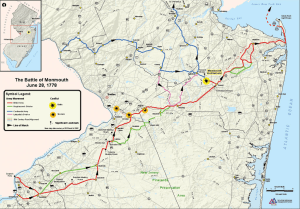
The New Jersey militia warned that the British army was on the move so Washington ordered Lee to attack and bring the British withdrawal to a halt until he could bring up the main strength of the American army along the Monmouth Road. Lee lay to the west of the Middletown road and should have delivered a coordinated attack on the slow moving column. Properly executed, Lee could have halted the British withdrawal to the north east and enabled the main American army under Washington to attack from the rear.
However; history records that Lee gave no proper orders to his commanders and permitted them to commit their troops as they saw fit. Various skirmishes with small parties of British troops took place as Lee’s force moved tentatively forward towards the Middletown Road. Confused fighting broke out with Clinton’s rearguard, largely composed of British regiments. Finally, Lee ordered his troops to into a cowardly retreat on the main American army. As he withdrew down the road, Clinton launched his troops in pursuit.
General Washington, bringing the main American army along the Monmouth road, encountered, not the rear of the British column, but Lee’s regiments, retreating in considerable disorder with the British advancing behind them.
*Memorably this is the one occasion Washington is said to have sworn. He deployed a consignment of oaths directed at Lee, to the admiration of those listening, before ordering Lee to the rear. Washington then galloped forward and began the task of rallying Lee’s disordered troops.
Washington ordered General Wayne, with the last of Lee’s regiments, Stewart’s 13th Pennsylvania and Ramsay’s 3rd Maryland, to form to the North of the road and hold the British advance. These regiments resisted strongly but were driven back by the British 16th Light Dragoons. Their stand gave Washington the time to form the rest of the American army, with artillery on Comb’s Hill to the South of the road. Ferocious fighting took place as the British attempted to drive back the American line. This was the first test of Steuben’s re-trained American Continental Foot regiments and they withstood the trial well. As the evening wore on, the British troops fell back, and returned to their journey north, leaving the Americans on the field. ~ Dorian F. Howard© 2016
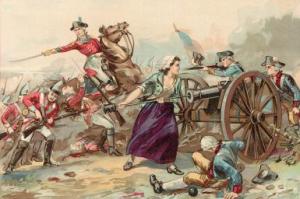
The Battle of Monmouth is often remembered for the legend of “Molly Pitcher.” While many of the details regarding “Molly Pitcher” have been embellished or are in dispute, the story refers to a woman who brought water to American artillery during the battle. This water was intended for swabbing the guns during the reloading process as well as cooling the hot gun crew. In one version of the story she replaced her husband on a gun crew when he fell wounded or from heat stroke. The Molly Pitcher of Monmouth, New Jersey is generally identified Mary Ludwig Hayes.
HISTORY & OBSERVATION OF “FLAG DAY” IN THE UNITED STATES
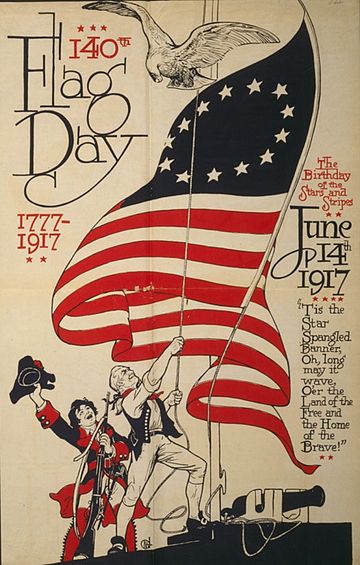
Flag Day is a celebration of the adoption of the American flag by Continental Congress in the First Flag Resolution of June 14, 1777. Although the 200-year anniversary of this date was celebrated by flying flags on public buildings and holding remembrances in several cities, Flag Day wasn’t officially recognized until President Harry Truman signed it into law in 1949. The week of June 14 is designated as “National Flag Week.” During National Flag Week, the president will issue a proclamation urging U.S. citizens to fly the American flag for the duration of that week. The flag should also be displayed on all Government buildings. Some organizations hold parades and events in celebration of our national flag and everything it represents. It’s also a time to remember and honor military men and women who defend our flag and our country. ~ JGT
HISTORY

The Fourth of July was traditionally celebrated as America’s birthday, but the idea of an annual day specifically celebrating the Flag is believed to have first originated in 1885. BJ Cigrand, a schoolteacher, arranged for the pupils in the Fredonia, Wisconsin Public School, District 6, to observe June 14 (the 108th anniversary of the official adoption of The Stars and Stripes) as ‘Flag Birthday’. In numerous magazines and newspaper articles and public addresses over the following years, Cigrand continued to enthusiastically advocate the observance of June 14 as ‘Flag Birthday’, or ‘Flag Day’.
On June 14, 1889, George Balch, a kindergarten teacher in New York City, planned appropriate ceremonies for the children of his school, and his idea of observing Flag Day was later adopted by the State Board of Education of New York. On June 14, 1891, the Betsy Ross House in Philadelphia held a Flag Day celebration, and on June 14 of the following year, the New York Society of the Sons of the Revolution, celebrated Flag Day.
Following the suggestion of Colonel J Granville Leach (at the time historian of the Pennsylvania Society of the Sons of the Revolution), the Pennsylvania Society of Colonial Dames of America on April 25, 1893 adopted a resolution requesting the mayor of Philadelphia and all others in authority and all private citizens to display the Flag on June 14th. Leach went on to recommend that thereafter the day be known as ‘Flag Day’, and on that day, school children be assembled for appropriate exercises, with each child being given a small Flag.
Two weeks later on May 8th, the Board of Managers of the Pennsylvania Society of Sons of the Revolution unanimously endorsed the action of the Pennsylvania Society of Colonial Dames. As a result of the resolution, Dr. Edward Brooks, then Superintendent of Public Schools of Philadelphia, directed that Flag Day exercises be held on June 14, 1893 in Independence Square. School children were assembled, each carrying a small Flag, and patriotic songs were sung and addresses delivered.
In 1894, the governor of New York directed that on June 14 the Flag be displayed on all public buildings. With BJ Cigrand and Leroy Van Horn as the moving spirits, the Illinois organization, known as the American Flag Day Association, was organized for the purpose of promoting the holding of Flag Day exercises. On June 14th, 1894, under the auspices of this association, the first general public school children’s celebration of Flag Day in Chicago was held in Douglas, Garfield, Humboldt, Lincoln, and Washington Parks, with more than 300,000 children participating.
Adults, too, participated in patriotic programs. Franklin K. Lane, Secretary of the Interior, delivered a 1914 Flag Day address in which he repeated words he said the flag had spoken to him that morning: “I am what you make me; nothing more. I swing before your eyes as a bright gleam of color, a symbol of yourself.”
Inspired by these three decades of state and local celebrations, Flag Day – the anniversary of the Flag Resolution of 1777 – was officially established by the Proclamation of President Woodrow Wilson on May 30th, 1916. While Flag Day was celebrated in various communities for years after Wilson’s proclamation, it was not until August 3rd, 1949, that President Truman signed an Act of Congress designating June 14th of each year as National Flag Day. Courtesy of USFlag.org:- The History Of Flag Day.
This Jersey Girl couldn’t let this article be complete without including a tidbit of New Jersey history. ~JGT
1913, City of Paterson, New Jersey
During the 1913 Paterson silk strike, IWW leader “Big” Bill Haywood asserted that someday all of the world’s flags would be red, “the color of the working man’s blood.” In response, the city’s leaders (who opposed the strike) declared March 17 to be “Flag Day,” and saw to it that each of the city’s textile mills flew an American flag. This attempt by Paterson’s leaders to portray the strikers as un-American backfired when the strikers marched through the city with American flags of their own, along with a banner that stated:
|
|
|
 Jersey Girl Today